
 by
by Why Do the Stars Look Different in Summer and Winter?
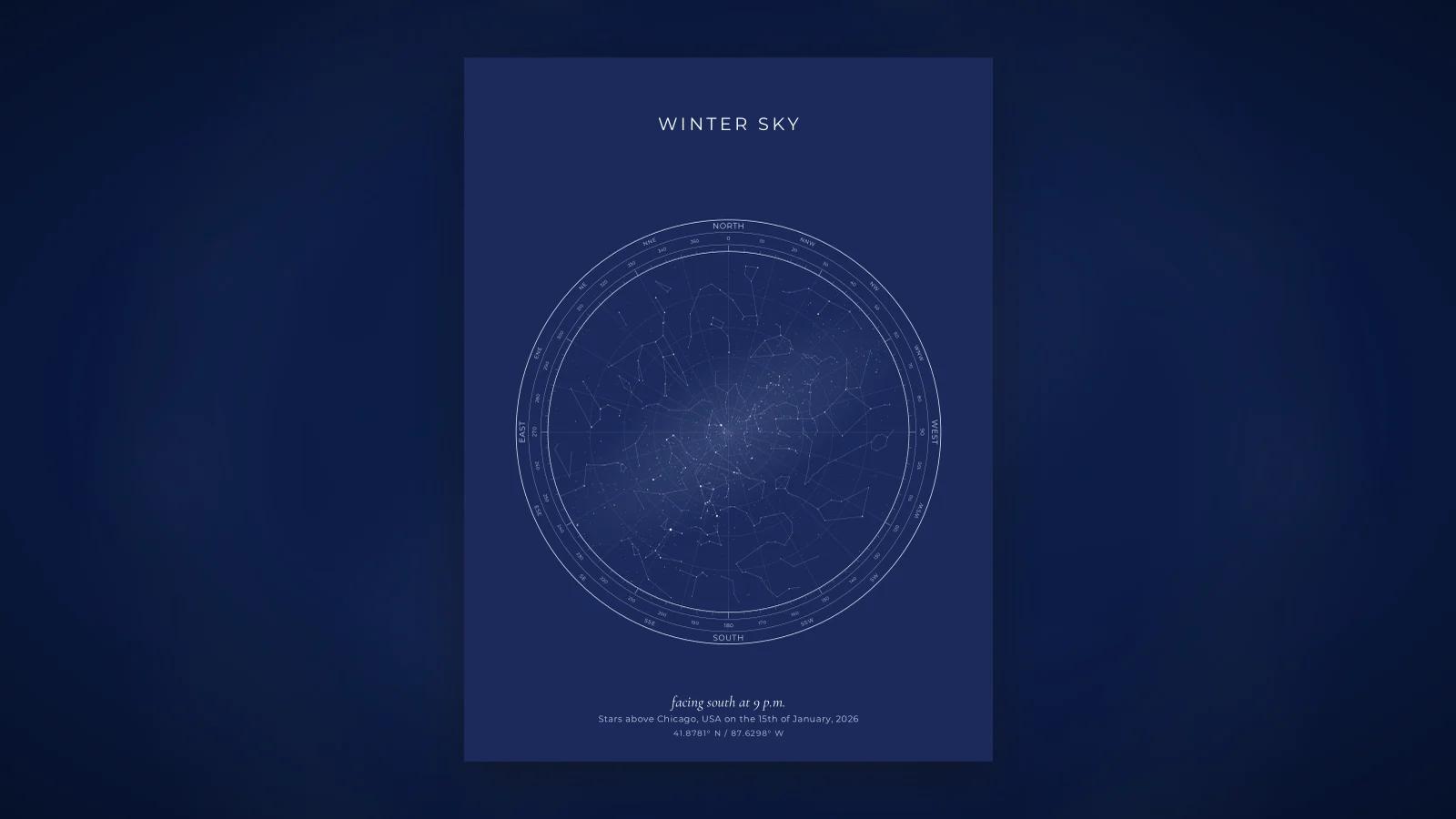
Step outside on a January evening from anywhere in the northern half of the world and Orion is there, bright and unmistakable, with Sirius blazing below him. Step outside on a July evening from the same spot and neither is anywhere to be found. In their place, high overhead, are three bright stars in a wide triangle and, low in the south, the curl of Scorpius.
The stars have not moved. Orion is still exactly where it was. What has moved is the Earth, and with it, the Sun's position against the background of stars. This article explains that mechanism from the ground up, then walks through what each season shows from the mid-northern latitudes where most of our readers live, and what stays the same all year.
The stars are fixed; Earth is not
On any timescale that matters to a person, the stars are fixed in their patterns. Orion looked the same to the Egyptians as it does to you, to within a hair. The constellations are, for practical purposes, a permanent wallpaper wrapped around the sky.
Two motions of the Earth determine which part of that wallpaper you see. Both are worth separating clearly, because people tend to blur them.
Rotation: once a day
Earth turns on its axis once every 24 hours, carrying the whole sky from east to west at about 15 degrees an hour. This is why stars rise and set, and why the sky at 9 p.m. differs from the sky at 3 a.m. It is the same reason the Sun rises and sets.
Revolution: once a year
Earth also travels around the Sun once a year. From where we stand, that makes the Sun appear to drift slowly eastward against the background stars, completing a full circuit of the sky in twelve months. The path it traces is called the ecliptic, and the constellations along it are the zodiac.
Here is the consequence that matters. Night is the half of the sky facing away from the Sun. Whatever constellations lie in the Sun's direction are up in the daytime, invisible against the blue. Whatever lies in the opposite direction is up at night. As the Sun drifts round the ecliptic through the year, the half of the sky it hides drifts with it, and the half we can see at night moves in step.
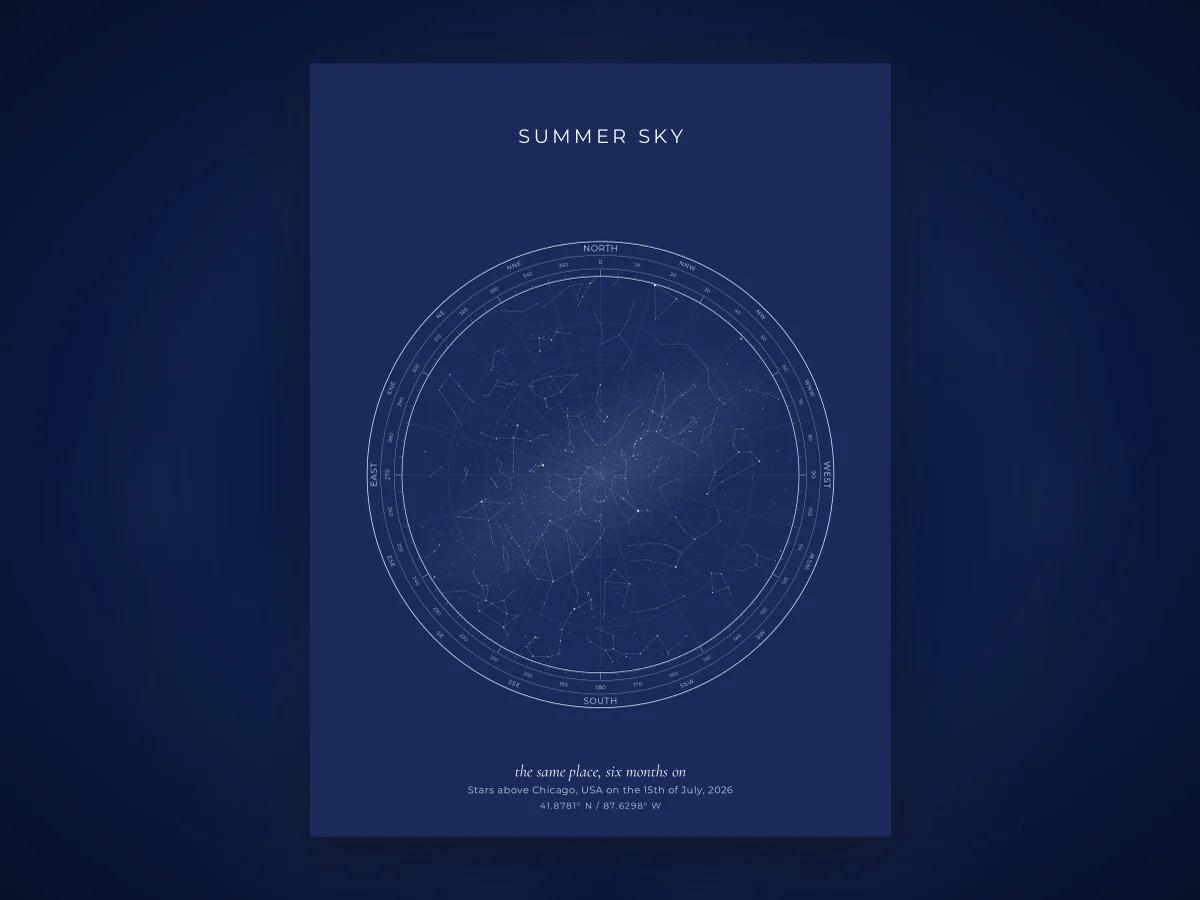
In late December the Sun sits in front of Sagittarius. Sagittarius, and Scorpius beside it, are therefore lost in daylight, while the opposite side of the sky, Orion, Taurus and Gemini, is up all night. In late June the Sun has crossed to Taurus and Gemini. Now Orion is the one lost in the glare, and Sagittarius and Scorpius own the night. NASA's overview of the seasons explains the orbital geometry, though it concentrates on temperature rather than stars; the sky follows the same annual circuit.
The four-minute drift
The change from one night to the next is small and steady. A given star rises about four minutes earlier each night than it did the night before.
The reason is a difference between two kinds of day. A solar day, noon to noon, is 24 hours. A sidereal day, the time for Earth to turn once relative to the stars, is about 23 hours 56 minutes. The four-minute gap is exactly the extra rotation Earth needs each day to catch up with the Sun, which has drifted a little eastward against the stars in the meantime.
Four minutes a night sounds like nothing. It adds up to about two hours a month and a full 24 hours in a year, which is the entire sky. So the sky at 10 p.m. in early March is the sky at midnight in early February and the sky at 8 p.m. in early April. If you go outside at the same clock time every night for a year, you watch the whole wallpaper scroll past, west to east, once.
This is also why a map of a birth in 1987 still matches the sky on the same date and hour today. The calendar and the stars come back into step each year to within about twenty minutes.
What each season shows from the northern mid-latitudes
The descriptions below are for evening skies, around 9 to 10 p.m. local time, seen from roughly 35 to 50 degrees north: most of the United States, southern Canada, Europe, Japan, and northern China. Shift the hour and the season shifts with it, at two hours per month.
Winter (December to February)
The showpiece season. Orion stands in the south, with the three belt stars in a short straight row. Follow the belt down and left to Sirius in Canis Major, the brightest star in the night sky; follow it up and right to the orange star Aldebaran in Taurus and, beyond it, the small cluster of the Pleiades. Above Orion sit Gemini, with Castor and Pollux side by side, and Auriga, with yellow Capella nearly overhead. Procyon in Canis Minor completes a large, bright ring of stars sometimes called the Winter Hexagon. Winter has more first-magnitude stars on view at once than any other season.
Spring (March to May)
Orion tips into the west and sets. Leo climbs high in the south, its head a backward question mark ending in Regulus. Behind Leo, the Big Dipper rides at its highest, almost overhead, and its handle curves down to the bright orange star Arcturus in Boötes and then on to Spica in Virgo: "arc to Arcturus, spike to Spica". Spring skies are quieter than winter, with fewer bright stars and more faint galaxies for those with telescopes.
Summer (June to August)
The Milky Way returns to the evening sky. Three bright stars, Vega in Lyra, Deneb in Cygnus and Altair in Aquila, form the Summer Triangle high overhead, with the Milky Way flowing through it from northeast to southwest. Low in the south, Scorpius curls above the horizon with red Antares at its heart, and beside it the teapot-shaped stars of Sagittarius mark the direction of the centre of our galaxy. Summer nights are short and warm, and this is when most people first learn the sky.
Autumn (September to November)
The Summer Triangle slides west. The Great Square of Pegasus stands high in the south, four moderately bright stars framing an empty patch of sky, with Andromeda trailing from one corner. Cassiopeia, the W, is near the zenith. Low in the south, alone in a dim region, sits Fomalhaut, the single bright star of the autumn sky. Autumn evenings are the year's least spectacular, which makes them a good time to notice the faint things.
The stars that never set
Not everything takes turns. Stars near the celestial pole circle it without ever dipping below the horizon. These are the circumpolar stars, and which ones qualify depends entirely on your latitude.
The rule is simple. The celestial pole sits above your horizon at an angle equal to your latitude. Any star within that angle of the pole never sets. From 40 degrees north, everything within 40 degrees of Polaris is circumpolar: Ursa Minor, most of Ursa Major including the whole Big Dipper, Cassiopeia, Cepheus, and most of Draco. From 55 degrees north, in Scotland or Denmark, the circle widens to take in more. From Miami at 26 degrees north it shrinks, and the Big Dipper's bowl sinks below the horizon on autumn evenings.
Circumpolar stars still move. They wheel around the pole once a day, so the Big Dipper stands on its handle in spring evenings and hangs below Polaris in autumn evenings. They simply never leave.
At the equator nothing is circumpolar; every star rises and sets. At the pole, everything is; no star ever rises or sets, and the same half of the sky circles overhead all night, all year.
The southern hemisphere
Everything above runs in reverse below the equator, with a different pole. Orion is a summer constellation in Sydney and Buenos Aires, up on warm December nights, and it appears upside down relative to the northern view, with the belt above Rigel rather than below Betelgeuse. Scorpius is a winter constellation there and passes nearly overhead.
The south has no bright pole star. The circumpolar region is marked instead by Crux, the Southern Cross, and the two bright pointer stars of Centaurus, which circle the empty patch of sky where the south celestial pole lies. From southern mid-latitudes these, along with Carina and the two Magellanic Clouds, never set, while the Big Dipper barely clears the northern horizon in autumn and Polaris never appears at all.

A note on precession
One more motion, slow enough to ignore for a lifetime and too large to ignore for history. Earth's axis wobbles like a spinning top, tracing a circle in the sky once every 26,000 years or so. Over the centuries this shifts which star sits near the pole (Vega will take Polaris's place in about 12,000 years) and slides the seasonal constellations slowly against the calendar. Within a human lifetime the shift is about a degree, two Moon widths. A well-made star map accounts for it when computing positions for a given date, which is one reason makers state a date range rather than pretending any year is equally sound. Our own range is 1900 to 2100, explained on the accuracy page.
Seeing your own season
The season you were born in fixed which of the skies above stood over you. A January birth carries Orion; a July birth carries the Summer Triangle. If you would like to see your own, the designer draws the sky for any date, time and place free in the browser, and the companion article on what the sky looked like on your birthday goes month by month through what a birthday sky contains. The birthday page shows how people have turned theirs into prints, in a navy sky or one of the other eleven designs.
Frequently asked questions
Why can I not see Orion in summer?
Because in northern summer Orion is on the same side of the sky as the Sun. It rises and sets with the Sun and is lost in daylight. Six months later Earth has moved to the other side of its orbit, the Sun sits in the opposite part of the sky, and Orion is up all night.
Do the stars actually move through the year?
The stars themselves stay put on any human timescale. What changes is Earth's position in its orbit, which changes which half of the sky is hidden behind the Sun. Each night a given star rises about four minutes earlier than the night before, which adds up to two hours a month and a full circuit in a year.
Which stars can I see all year round?
The circumpolar stars, the ones close enough to the celestial pole that they circle it without ever dipping below your horizon. How many depends on your latitude. From 40 degrees north, most of Ursa Major, Ursa Minor, Cassiopeia, Cepheus and Draco never set. From the equator nothing is circumpolar; from the pole, everything is.
Are the seasonal constellations the same in the southern hemisphere?
The seasons are reversed and the pole is different. Orion is a summer constellation in Australia, appearing during December and January, and it stands upside down compared with the northern view. Crux and the pointer stars of Centaurus take the place of the Big Dipper as the circumpolar signposts.
Why does midnight on my birthday show a particular constellation high in the south?
At midnight you face directly away from the Sun, so the constellation highest in the south is the one opposite the Sun on the ecliptic. The Sun's own zodiac constellation at your birth is invisible, behind the daylight; the one across from it is the one that stands overhead at midnight.