
 by
by Star Map Wording Ideas: 120+ Titles and Subtitles by Occasion
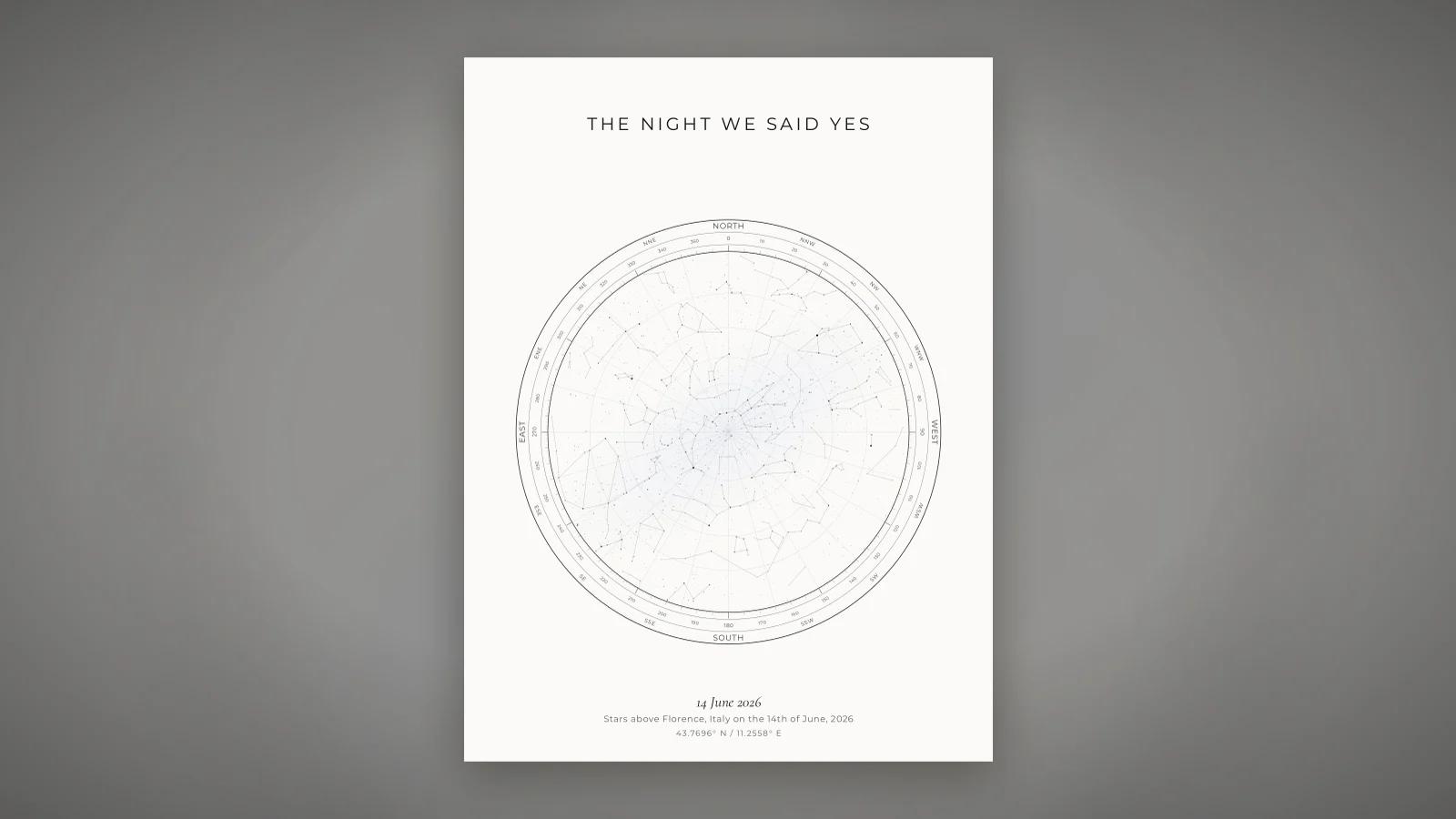
The wording on a star map is a small amount of text carrying a large amount of weight, and getting the balance right, specific enough to matter, short enough to actually fit, is worth more thought than it usually gets. This guide covers the rules that make wording work, followed by more than 120 examples organised by occasion, a few public-domain lines that are safe to print, and pairs that show how a title and subtitle should split the work.
Why wording matters more than it seems
The sky does most of the visual work on a star map, and it is tempting to treat the text as an afterthought, a label rather than a real design decision. In practice, wording is what turns an accurate chart into a keepsake with meaning attached, and it is also the one part of the design entirely within your control, unlike the stars themselves, which are fixed by your date and place. Getting it right is worth the extra few minutes it takes.
The rules that make wording work
Keep the title to two to five words. A star map's title needs to read clearly at every size, from a small screen preview to a large framed print, and a longer title either shrinks illegibly or wraps across multiple lines in a way that disrupts the design's calm, spacious feel.
Make it specific, not generic. "Our love story" could belong to any couple; "the night you said yes" belongs to exactly one. The more specific the wording, the more it will still mean something to you in twenty years, when a generic sentiment might feel like it could belong to anyone.
Decide on a subtitle deliberately, not by default. A subtitle is optional and works best as a short, quieter complement to the title, not a second sentence competing for attention. If the title already says what needs saying, consider leaving the subtitle blank.
Coordinates and the date line are matters of taste, not obligation. Some people like the precise, almost scientific feel of visible coordinates; others prefer the design without them. Neither is more correct.
Anniversary and wedding
These work well on any of our paper or navy disc designs, both popular for anniversary and wedding keepsakes; see our anniversary gift ideas guide for more on the occasion itself.
- The night we said yes
- Where two became one
- The night you became mine
- Under this sky, together
- Forever starts here
- [Two names] · [wedding date]
- The night everything changed
- Our first night as one
- Written in the stars
- The sky above our beginning
- One night, one sky, one love
- Where our story began
- The night I knew
- [City name] · [year]
- Ten years under the same stars
- Still the same sky, still us
- The first night of forever
- [Number] years and counting
- I do, under these stars
- Mr & Mrs · [date]
Engagement
Designs like heart are a common choice here; our guide to engagement gift ideas covers the wider occasion.
- She said yes
- He said yes
- The night you asked
- The question, under this sky
- [Proposal date] · [location]
- The night it became forever
- Yes, under every star
- The sky above the question
- The easiest answer I ever gave
- One knee, one question, one sky
The night we met
Our guide to turning a first night into a keepsake covers how to pin down the date and place before you choose the words.
- The night we met
- Where it all began
- [Time] · [place] · [date]
- The night I noticed you
- Everything changed at [time]
- The first night of us
- [City] · the night we met
- Before we knew
- Hello, you
- The night the story started
Valentine's Day
The crimson design suits these, and our Valentine's gift guide has ship-by dates if you are ordering a framed print.
- Be mine
- Every star, still you
- My favourite night
- Always you
- You, me, and this sky
- Our first Valentine's · [year]
- The sky I'd choose again
- Mine, under every sky
New baby
Softer designs like moon and heartwhite suit these especially well; our nursery wall art guide has more ideas for the room it will hang in.
- Welcome, [name]
- The night you arrived
- Under this sky, you were born
- [Baby's name] · [birth date]
- The night our world changed
- Written in the stars for you
- Our little star
- The sky the night you came
- [Name]'s first sky
- The night we became parents
- Every star for you
- The night you made us three
- Welcome to the world, [name]
- [Birth date] · [time of birth]
- The sky above your first breath
- Hello, little one
Birthday
- Born under this sky
- [Name] · [birth date]
- The sky the night you arrived
- Every year, this same sky returns
- Written in the stars for [name]
- Thirty years ago tonight
- The sky you were born under
- Happy birthday, [name]
Mother's Day and Father's Day
These are written from a child to a parent, and usually point at the child's own birth night.
- For Mum · the night you gave me the world
- For Dad · the night I made you a father
- The night you became Mum
- The night you became Dad
- Where your job began
- [Your name] · [your birth date]
- Thank you for every night since
- The first night you held me
Long distance
Our long-distance gift guide explains how two maps of the same moment from two cities work as a pair.
- The same sky, wherever you are
- [City A] · [City B]
- Look up, I'm there too
- Miles apart, same stars
- Under the same sky
- Until we're under one roof
Christmas and the holidays
- Our first Christmas
- Christmas Eve · [year]
- The night before
- Home for the holidays
- [Family name] · Christmas [year]
- Silent night · [place]
Graduation, new home and other milestones
- Class of [year]
- The night you graduated
- Our first home
- [Address or city] · [move-in date]
- The night we got the keys
- Home, under these stars
- The night it all paid off
- Here's to what's next
Memorial
Restraint matters most here; our memorial gift guide covers the wider etiquette around this occasion, including timing.
- In loving memory
- [Name] · [birth year]–[death year]
- Always with us
- Forever in our hearts
- The sky that night
- [Name] · always loved
- Until we meet again
- Still here, in every star
Pet memorial
Our pet memorial guide covers the gentler side of choosing a keepsake for an animal.
- Always by my side
- Good dog · [name]
- [Pet's name] · [year]–[year]
- My best friend
- Forever our good [girl/boy]
- The night we brought you home
Friendship
- Friends since · [date]
- The night we became family
- [Two names] · since [year]
- The sky over our best night
Short public-domain lines
Old poems are out of copyright, so they can be printed without permission. These are the most used, and they are short enough to fit as a subtitle.
- "I have loved the stars too fondly to be fearful of the night." (Sarah Williams, 1868)
- "Doubt thou the stars are fire." (Shakespeare, Hamlet)
- "She walks in beauty, like the night." (Byron, 1814)
- "Two souls with but a single thought." (Friedrich Halm, 1842, in its English translation)
Song lyrics and modern poems are a different matter: most are still under copyright, and printing them on something you sell or give can need permission. For a personal gift the risk is small, but the public-domain lines above avoid the question entirely.
Title and subtitle pairs that work together
A title and a subtitle work best when one carries the feeling and the other carries the fact. A few pairs, to show the balance:
- The night we met · 12 August 2019, Portland
- Welcome, Amara · the night you arrived
- Where two became one · Lake Como, 14 May 2022
- Always with us · 3 November 2020
- Our first home · the night we got the keys
- She said yes · a Tuesday in October
Notice that none of them repeat themselves. If the title says "the night we met", the subtitle does not need to say "our first night together" as well; it can give the date, the place, or nothing at all.
Writing your own wording from scratch
If none of the examples above fit, a few prompts tend to produce better original wording than staring at a blank field. Ask what a stranger would need to be told for the print to make sense to them; often the answer is almost nothing, which is a sign the wording can be shorter than you first assumed. Ask what you would want to read on this print in twenty years; sentimentality that feels natural now can read as dated later, while something more understated tends to hold up. And read any candidate line out loud; wording that sounds slightly awkward spoken aloud usually reads the same way printed.
Numbers, dates and coordinates as wording
Some of the strongest star map wording is not a sentence at all, but a number: a date written out in full ("14 June 2025"), a set of coordinates, a time. These work well precisely because they read as evidence rather than sentiment, letting the sky itself carry the emotional content while the text supplies the specific, checkable facts. If you want a print that leans quiet and precise rather than expressive, building the wording entirely from a date, a place name and coordinates, with no title at all beyond the two names, is a legitimate and increasingly common choice.
Wording in another language
If you or the recipient are more comfortable in a language other than English, most of the phrases above translate naturally and lose little in translation, since they tend to be short, concrete statements rather than wordplay or rhyme that depends on English specifically. Keep the same length guidance in mind: two to five words for a title regardless of language, since some languages run longer per word and may need trimming to stay legible at the same print size.
How much wording is too much
The most common mistake is stacking a long title, a full subtitle, a date line, coordinates, and a place name all at once, which crowds a design that generally reads best with breathing room. A good rule of thumb: choose one primary line (the title), decide whether a short subtitle genuinely adds something or is better left out, and treat the date and coordinates as optional supporting details rather than required elements. If in doubt, try the design with less text first; it is easier to notice something missing than to unclutter a design that has too much.
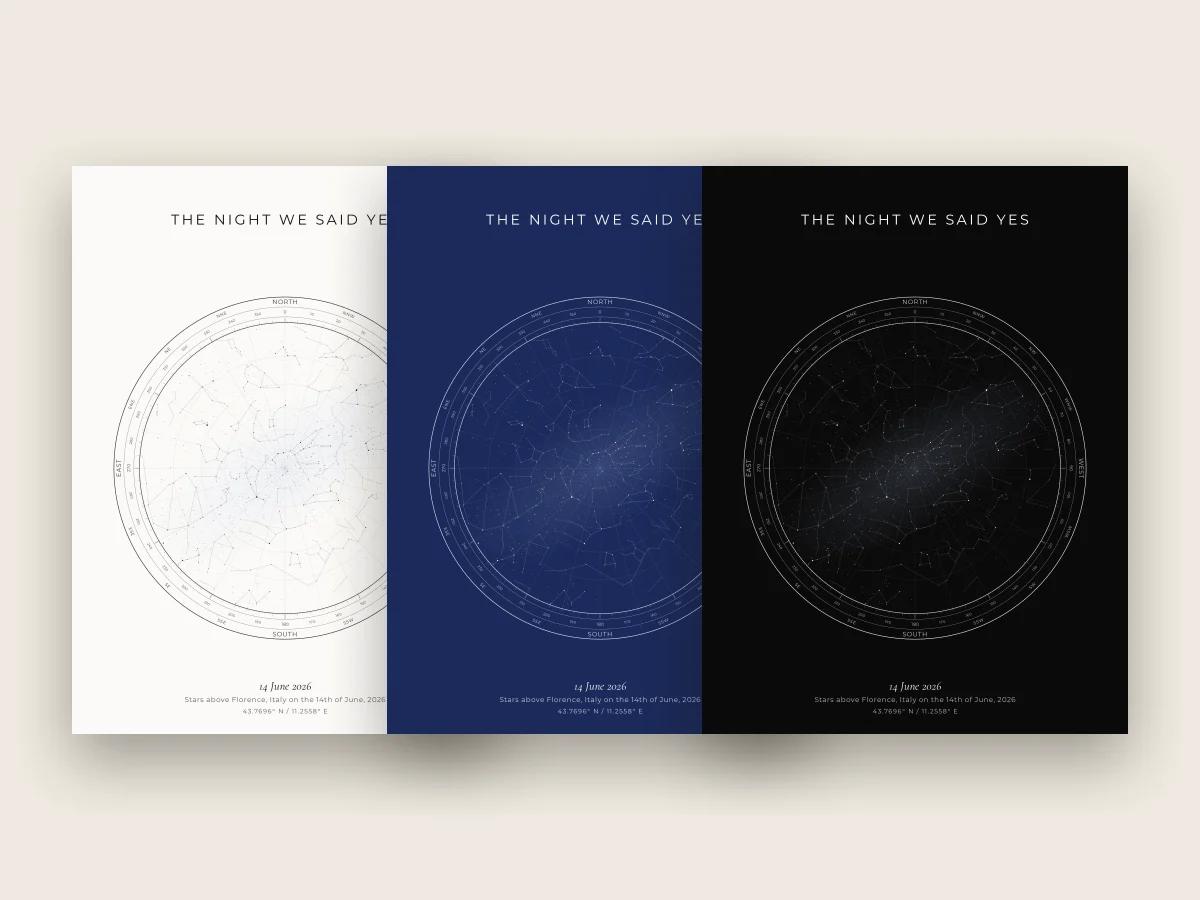
Trying your own wording
The best way to judge wording is to see it on the actual design, since a phrase that reads well as text on a page can feel too long or too short once it is set against a real sky. Our designer lets you try different titles and subtitles on a live preview, free, before you commit to anything, so you can see exactly how your chosen words sit against your own date and place.
Frequently asked questions
How long should the title on a star map be?
Two to five words works best for a title, since it needs to read clearly at a glance and stay legible at every print size from a small digital file to a large framed poster. Longer titles either shrink to an awkward size or wrap across multiple lines, which usually looks cluttered on a design meant to feel calm and spacious.
What should I write on a star map for an anniversary?
A short line referencing the specific relationship or moment works best: "the night we met," "the night you said yes," or simply both names and the date. Avoid generic phrases that could apply to any couple; the wording works best when it is specific to yours.
Do I need to include coordinates on a star map?
No, coordinates are optional and mostly appeal to people who like the technical, precise feel they add. Many designs look equally good, sometimes more restrained, without them; it comes down to personal taste rather than a rule.
What is good wording for a memorial star map?
Simple and understated: a name and two dates, or a short phrase like "always with us" or "in loving memory," without embellishment. Memorial wording benefits especially from restraint; the sky itself carries the emotional weight, and the words do not need to do more work than necessary.
Can I use a quote or song lyric on a star map?
Yes, provided it fits the character limit gracefully and you have the rights to reproduce it if it is a copyrighted lyric for anything beyond personal use. A short, well-known line works better than a long verse, which will not fit legibly on the design.