 by
by Star Map vs Moon Phase Print: Which Suits Your Moment?
Both a star map and a moon phase print take a specific date and turn it into a piece of art, and both make genuinely good personalised gifts. They are not the same thing, though, and knowing the difference helps you choose the one that will actually suit your moment.
The short answer
| Star map | Moon phase print | |
|---|---|---|
| What it shows | Every star and constellation above one place at one minute | The Moon's lit shape on one date |
| Tied to a place? | Yes: move 500 miles and the sky changes | No: the phase is the same for everyone on Earth that night |
| Tied to a time? | To the minute | To the day |
| Look | Detailed, many points of light | One clean shape, minimal |
| Best for | A night where the place matters: a wedding venue, a hospital, a first date | A night where the Moon itself mattered, or a matching series |
| Works as a series? | Yes, but each piece looks very different | Very well: each piece looks alike, only the phase changes |
Why this comparison comes up so often
Both products emerged from the same broader trend, personalising a moment through astronomy rather than a generic object, and both are frequently marketed to the same audience: couples marking an anniversary, parents marking a birth, anyone wanting a keepsake tied to a date that matters. Because they are sold through similar channels and to similar buyers, it is genuinely common to be choosing between the two rather than immediately knowing which one you want, which is exactly the decision this article is meant to help with.
What each one actually shows
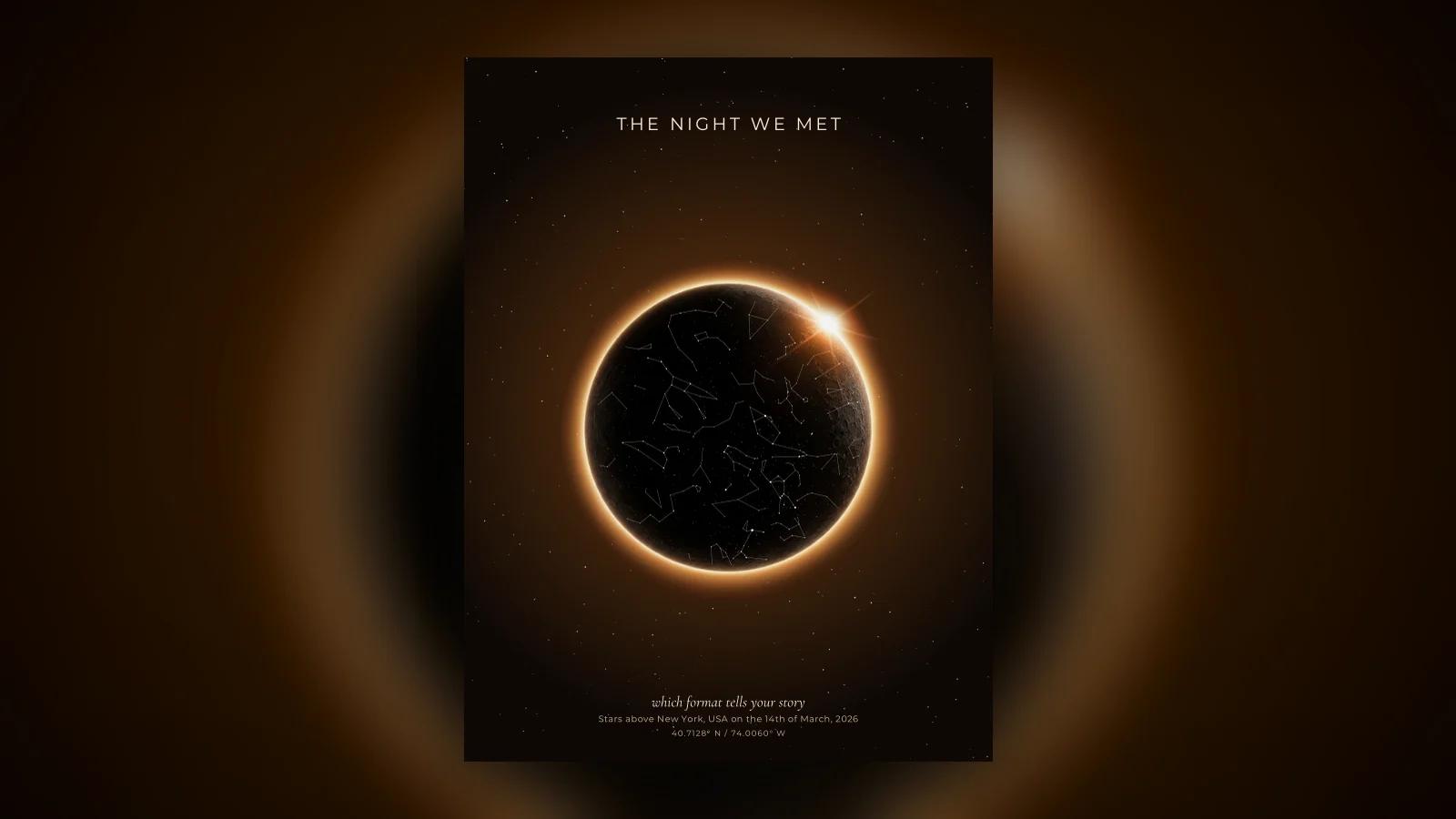
A star map plots the full night sky, roughly 9,000 stars and all 88 constellations in the most detailed versions, computed for one exact place and moment. It shows what the whole sky looked like, not just one object within it, and typically includes a compass ring, sometimes coordinates, and the constellation lines connecting recognisable shapes.
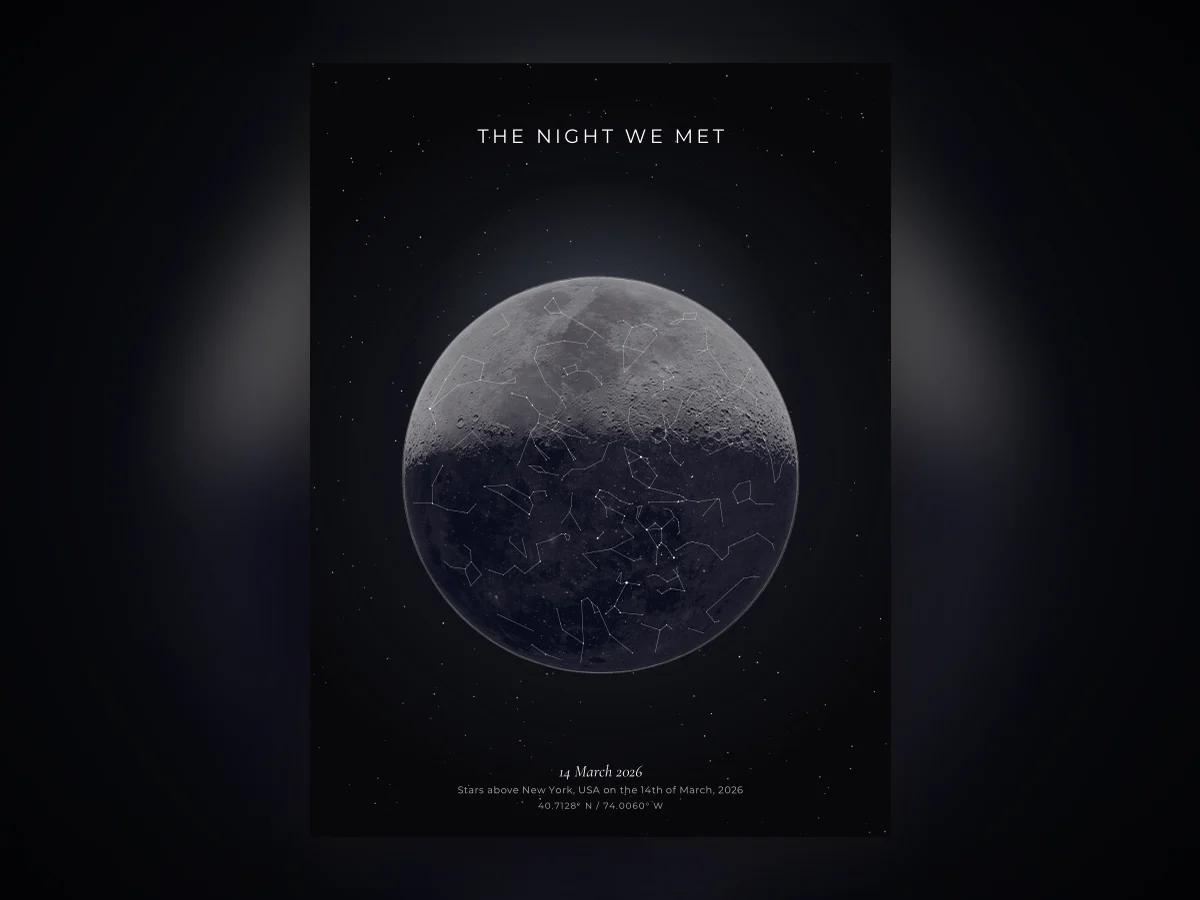
A moon phase print shows a single object: the Moon, in its correct illuminated shape for a given date, often rendered as one clean graphic rather than a full sky scene. Some versions add a simple star field behind it; the more common minimalist style presents the Moon phase alone, sometimes with a date or names beneath it.
What a moon phase print cannot show
This is the difference most people miss. The Moon's phase is a property of the whole planet at a given moment: when it is a waxing crescent in New York, it is a waxing crescent in Paris and Tokyo too. The only things that change with your location are whether the Moon is above the horizon at that hour and which way the lit side appears to tilt. So a moon phase print of your wedding day is, strictly, identical to a moon phase print of every other wedding held on that date anywhere in the world.
A star map is the opposite. The sky above one city at 21:00 is genuinely different from the sky above a city a few hundred miles away at the same minute, and very different from the sky an hour later. That is why a star map can be said to belong to one place and one moment, and a moon phase print to one date. Neither is better, but if what you want is something that could only be yours, the place-and-minute specificity of a star map is the stronger claim.
Accuracy in both formats
Both formats can be computed with genuine astronomical precision. A star map's star positions and a moon phase print's illumination percentage are both calculable exactly for any given date, using well-established methods; accuracy in either case depends on the maker's process, not on which format you pick. If accuracy matters to you, check how any maker, star map or moon phase, describes their method before buying, the same standard covered on our own accuracy page.
Which occasions suit a star map
A star map suits a moment where the entire sky, and the specific place it stood over, is part of the story: a wedding at a particular venue, the night you met in a particular city, a birth at a specific hospital. Because it shows the full sky rather than one object, it also captures the constellations that were visible, which some people find adds a layer of detail and specificity a single-object print does not.
Which occasions suit a moon phase print
A moon phase print suits someone with a specific attachment to the Moon itself, an interest in astrology, a wedding held explicitly under a full moon, a birth on a night with a notably dramatic phase, or simply a stylistic preference for the cleaner, more minimalist look a single graphic object offers over a full star field. It also tends to work well as part of a series, a set of moon phases for each year of a relationship, or one for each family member's birth, in a way a full star map series would look visually busier.
Do you have to choose?
Largely, yes, unless you find a maker who explicitly plots both. Our own star maps show the fixed stars and the 88 constellations only; we leave the Moon and planets out deliberately, since both move independently of the star field and require their own calculation to place accurately, rather than tacking on a decorative Moon graphic with no real position behind it. Our companion article on what star maps do and don't show goes into this in more detail.
If the Moon mattered to your night, a full moon over the wedding, a particular phase the evening someone was born, the cleanest honest option with a star-only map is to put it in the wording: "under a full moon" as a subtitle costs nothing and is exactly as accurate as a drawn Moon would be, without implying a position we have not actually calculated.
How to check the Moon's phase for your date, free
If you want to know what the Moon was doing on your night, before choosing either format or before writing a subtitle, you do not need to buy anything:
- Search for a moon phase calendar for the month and year. Any reputable astronomy or time-and-date site will show the phase and the percentage lit for each day.
- For more detail, including whether the Moon was actually above the horizon at your hour and where in the sky it sat, enter your date, time and place in Stellarium Web, a free planetarium that runs in the browser.
- If the phase is part of the memory, write it into the wording: "under a full Moon" or "beneath a waxing crescent" as a subtitle is accurate, costs nothing, and does not pretend to plot anything it has not calculated.
Our guide on how accurate star maps are walks through checking a star map against Stellarium in the same way.
Design and visual style differences
A star map, by its nature, tends toward a busier, more detailed visual, dozens or hundreds of visible points connected by constellation lines within a compass ring. A moon phase print tends toward the opposite: a single, clean, high-contrast shape against a plain or lightly textured background. Neither is objectively more attractive; the choice often comes down to whether a recipient's taste runs toward detailed, information-dense designs or toward minimal, graphic ones. Some couples resolve this by choosing one format for a special occasion, a wedding, and the other for a more everyday keepsake, rather than treating it as an either-or decision for every gift.
Series and collections
Moon phase prints work particularly well as a series: one for each month of a pregnancy showing the changing phase, one for each year of a relationship, or one per family member's birth. Because each print in a moon phase series looks structurally similar with only the phase changing, a matched set reads cleanly as a collection. A star map series is possible too, but because each map's full sky differs more dramatically from the next, a matched set of star maps reads less as a uniform collection and more as a set of distinct, individually detailed pieces; some people prefer that variety, others prefer the moon phase format's consistency.
Price and format comparison
Both formats are typically sold through similar commercial structures: a free or low-cost digital preview, digital files at a moderate price for printing yourself, and framed prints at a higher price with shipping included. Our own digital star map files are $25 and arrive by email in minutes; framed prints are $69 to $179 with free shipping to the US and 40+ countries. Moon phase prints from specialist makers in that category tend to sit in a comparable range, though exact pricing varies by seller and size.
A worked example
Imagine a couple choosing a keepsake for their wedding, held outdoors under a full moon they still talk about. A star map of that night captures the full sky, the constellations visible, the specific venue's coordinates, and can note the moon phase in the wording even though it will not be drawn. A moon phase print captures the moon itself as the central image, with the date underneath, foregrounding the exact detail they remember most vividly. Neither is the "correct" choice; a couple drawn more to the venue and the wider night would likely prefer the star map, while a couple whose strongest memory is specifically the moon overhead would likely prefer the moon phase print.
By occasion
| Occasion | Usually the better fit | Why |
|---|---|---|
| Wedding | Star map | The venue is part of the story, and the map is tied to it |
| Engagement | Star map | The proposal happened somewhere specific |
| New baby | Either | A star map for the hospital and hour; a moon phase if you want a sibling series |
| Pregnancy journey | Moon phase | Nine prints, one per month, read well as a set |
| Anniversary | Star map | Most couples remember the place as much as the date |
| Memorial | Either | A quiet star map or a single moon; both suit a restrained design |
| Astrology fan | Moon phase | The Moon's phase carries the meaning for them |
| "The night we met" | Star map | The place is usually the whole point |
These are tendencies, not rules. If the person you are buying for talks about the Moon every time they describe the night, that tells you more than any table.
Which one to choose
If the story you are telling depends on the place as much as the moment, a full star map captures more of that specificity. If the story is really about the Moon itself, its phase on a particular night, a personal or astrological connection to it, a dedicated moon phase print is the more direct choice, since a star-only map cannot show it accurately. Our own moon design, worth naming clearly, is a decorative style built around a large moon graphic behind the star field; it is a design choice, not a plot of the real lunar phase for your date, the same distinction our accuracy page draws for every design.
The designer lets you preview a full star map, free, before you decide whether it or a dedicated moon phase print actually suits your moment. If you land on a star map, our guide to wording ideas will help you choose what it should say.
Frequently asked questions
What is the difference between a star map and a moon phase print?
A star map plots the full arrangement of stars and constellations as they stood over a specific place and moment, while a moon phase print shows only the Moon's illuminated shape on a given date, often as a single simplified graphic rather than a full sky. They highlight different things about the same night.
Which is more accurate, a star map or a moon phase print?
Both can be highly accurate if computed properly, since both the positions of stars and the phase of the Moon on a given date are precisely calculable using standard astronomical methods. Accuracy depends on the maker's method, not on which format you choose.
Can I get both the stars and the Moon phase on one print?
Some makers plot the Moon's real position and phase alongside the stars; check specifically, since many star maps, ours included, deliberately leave the Moon out because plotting it accurately requires a separate calculation from the star positions. Our maps show the fixed stars and constellations only; if the Moon's real phase matters to your keepsake, look for a maker who states plainly that they include it, or note the phase in the print's wording instead.
Is a moon phase print a good gift for a specific date?
Yes, particularly for someone who has a strong personal connection to the Moon itself, a shared interest in astrology, a wedding under a full moon, or simply a preference for its simpler, more graphic look compared to a full star field.
Which should I choose for an anniversary or wedding gift?
A star map suits a date where the full sky and the specific place matter to the story; a moon phase print suits someone drawn specifically to the Moon's symbolism or its simpler visual style. Neither is more correct, and the choice comes down to what the recipient will connect with more.