
 by
by Do Star Maps Show Planets, the Moon, or the Milky Way?
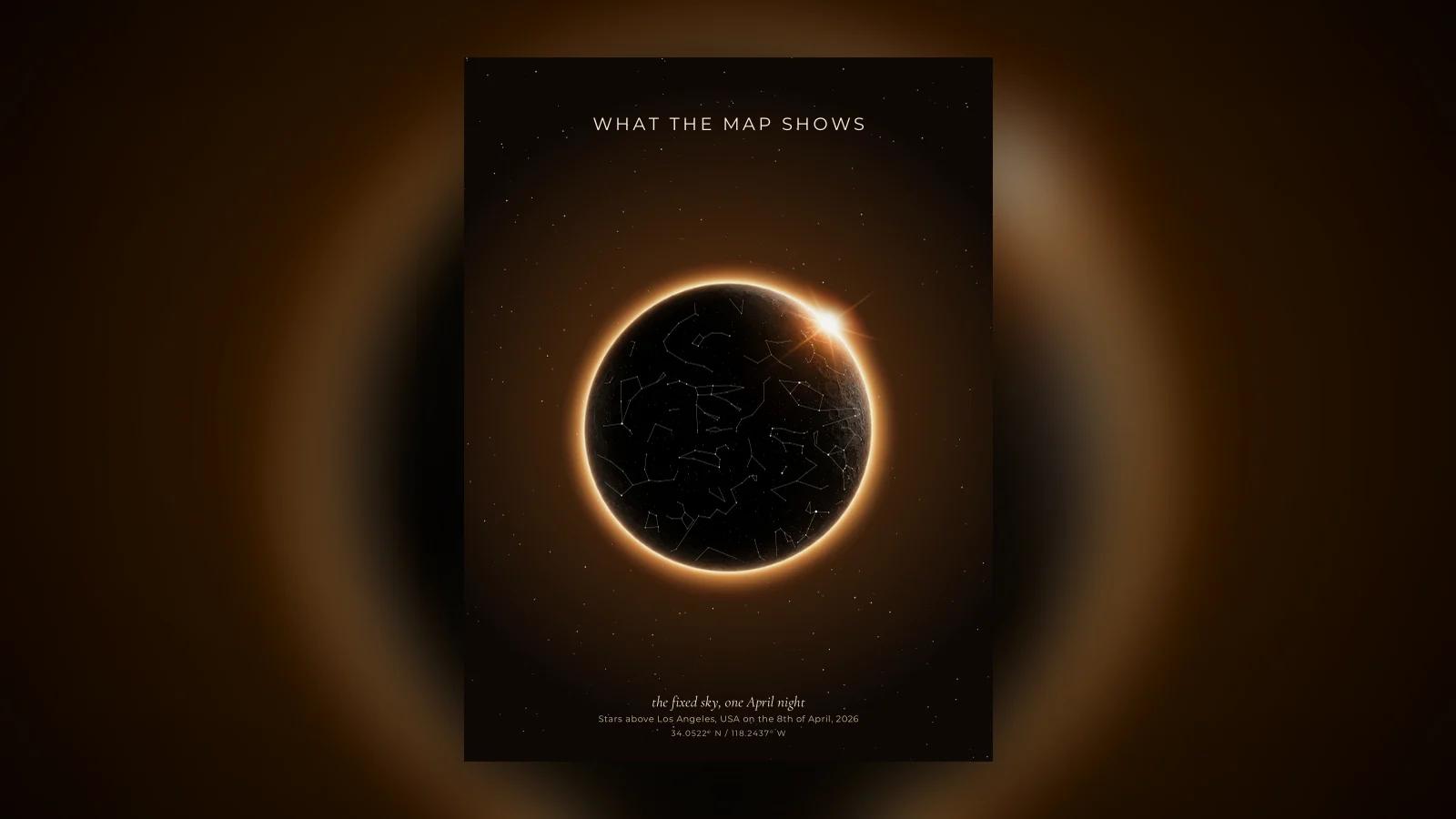
Every so often someone looks at a star map of their wedding night and says: but there was a full Moon. Or: I remember a very bright star in the west that evening, and it is not here. They are usually right about what they remember. The map is not wrong either. The two are describing different things, and the difference is worth explaining properly, because it decides whether a star map is the right object for the moment you want to keep.
The short version: most custom star maps, including ours, draw only the fixed stars and the constellations. The Moon and the planets are left out, on purpose, because they do not stay put. The Milky Way, which does stay put, is often included. The rest of this article explains why, which makers do things differently, how to check before you order, and exactly what our maps contain.
The fixed sky and the wanderers
The ancient distinction still holds. The stars are "fixed": on any human timescale they keep the same patterns relative to one another, so Orion is the same shape tonight as it was for Ptolemy. What changes from night to night and season to season is which part of that fixed pattern is above your horizon, and that is a matter of date, time and place. A star map is a picture of the fixed sky, turned to your moment.
Against that backdrop, a handful of objects move. The Greeks called them planetes, wanderers, and counted the Sun and Moon among them. The five naked-eye planets, Mercury, Venus, Mars, Jupiter and Saturn, and the Moon all drift through the constellations of the zodiac on their own schedules.
How fast they move
The Moon is the fastest. It travels about 13 degrees eastward against the stars every day, roughly the width of a fist held at arm's length, and circles the whole sky in a month. Its phase changes visibly from one night to the next. NASA's Moon pages explain the phase cycle and the geometry behind it.
Mercury and Venus never stray far from the Sun, so they appear only in twilight, and shift week by week. Mars crosses a constellation in a matter of weeks. Jupiter spends about a year in each zodiac constellation; Saturn, about two and a half years. Over the span of a lifetime, each of them visits every part of the zodiac many times.
Why that matters for a map
Because of that motion, a planet's position is specific to a date in a way a star's is not. A map of the fixed stars for a given date and hour would be almost identical for the same date and hour a year later, or a decade later. A map with the planets on it would be different every year. There is nothing wrong with that; it simply means the planets belong to a different kind of picture.
And they are conspicuous. Venus can reach magnitude minus 4, far brighter than any star. Jupiter reaches about minus 2, brighter than Sirius. If either was in the evening sky on the night you remember, it will have been the brightest point up there, and its absence from a fixed star map is exactly the kind of thing a careful person notices.
Why most star maps leave them out
Makers who omit the Moon and planets, and we are among them, do so for a mix of reasons. The honest ones are these.
The map is a portrait of the fixed sky. That is the tradition it descends from, the planisphere and the star chart, both of which show only stars because they are meant to work on any night. A custom star map narrows that to one night, but keeps the same subject.
Scale. The Moon is half a degree across. On a map where the horizon circle spans 180 degrees of sky, a true-to-scale Moon is a dot smaller than the bright stars around it. To be recognisable as the Moon, with a visible phase, it has to be drawn many times its real size, and a Moon drawn that large hides every star behind it. There is no scale at which it is both honest and legible.
Clutter. Planets carry no constellation lines and no fixed neighbours. Drawn as dots they look like misplaced bright stars; drawn as symbols they turn a star chart into a diagram. Either way the picture reads less cleanly as a constellation map.
Daytime moments. Many of the moments people map, births especially, happen in daylight. The stars are still overhead and a fixed star map shows them. The Sun is also overhead, and a map that plotted the Sun and Moon would have to put a Sun in the middle of the sky. Leaving the solar-system bodies out keeps daytime and night-time maps consistent.
None of these is a law. They are design decisions, and the point of stating them is so that you can decide whether they suit you.
Some makers do plot them
Not everyone makes the same choice. GreaterSkies, for example, computes and draws the planets and the Moon at their positions for the chosen moment, and says so on its site. Some smaller makers show a Moon phase graphic for the date, sometimes as a separate element beside the star field rather than at its true place in the sky. If the Moon or a planet is central to the story you are keeping, one of those approaches may be the right one, and there is nothing disloyal about choosing it.
What to be wary of is a maker who is unclear. A decorative moon in the corner of a design is fine if it is described as decorative. It is not fine if it is left to imply that the Moon looked like that, in that place, on that night.
The Milky Way is different
The Milky Way is the combined glow of the disc of our galaxy, seen edge-on from inside it. Unlike the Moon and planets, it is fixed among the stars; it is, in fact, made of stars, along with dust and gas. So its position for any moment can be computed exactly, and it can be drawn on a fixed star map with a clear conscience.
Most makers who include it draw it as a soft, pale band. That is an approximation, because the real thing is patchy, irregular, and varies enormously with the darkness of the sky, but the band's position and orientation are correct. On northern summer evenings it arches high overhead through Cygnus; on northern winter evenings it runs fainter through Auriga and past Orion; from the southern hemisphere in winter it passes overhead through Scorpius and Sagittarius, brighter than anywhere in the north.
Ours draws the Milky Way as a band and lets you turn it on or off, since some people prefer the stars alone.
What about clusters and galaxies?
Two things people sometimes ask after. The Pleiades are a cluster of stars, several of them bright enough to appear individually on a naked-eye map, so they show up as a tight knot of dots in Taurus. The Andromeda Galaxy is a faint smudge rather than a star and is not plotted on most maps, ours included; nor are nebulae, comets, meteor showers, satellites or the aurora.
How to check what a maker includes
Three steps, none of them long.
Read the accuracy page. A maker who takes the astronomy seriously will list the catalog, the magnitude limit, the constellations, and what is and is not plotted. Silence on the Moon and planets usually means they are absent.
Look at a sample closely. Sample maps for a stated date and place can be checked. If a sample shows a Moon, is it at a plausible position and phase for that date, or is it the same graphic on every design?
Preview a test date. If the maker offers a free preview, choose a date and evening hour when you know a bright planet was high, check it in a planetarium app such as Stellarium Web, and compare. Where the app shows Jupiter, the maker's preview will show either a planet symbol or plain stars. That answers the question in under a minute.
What our maps include, exactly
For clarity, here is the full list for a map from our designer:
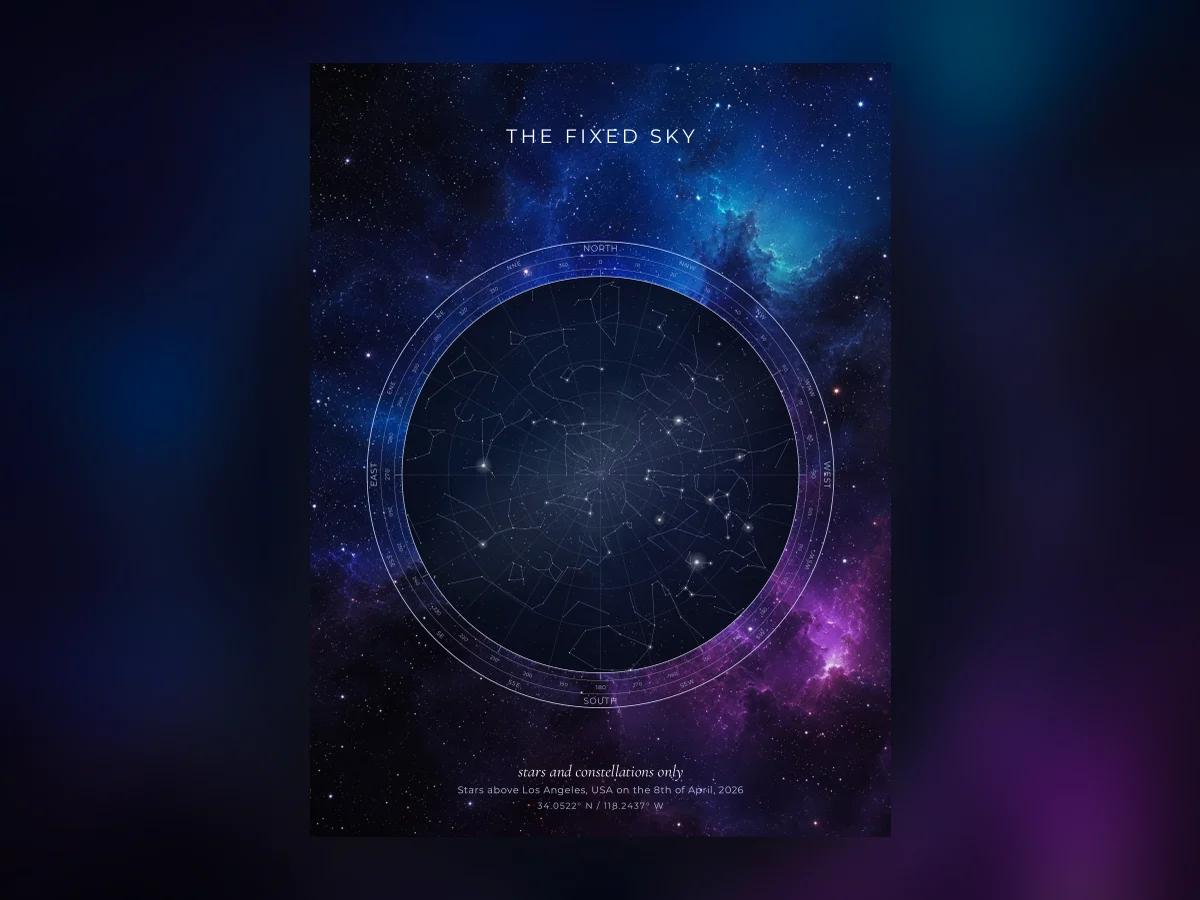
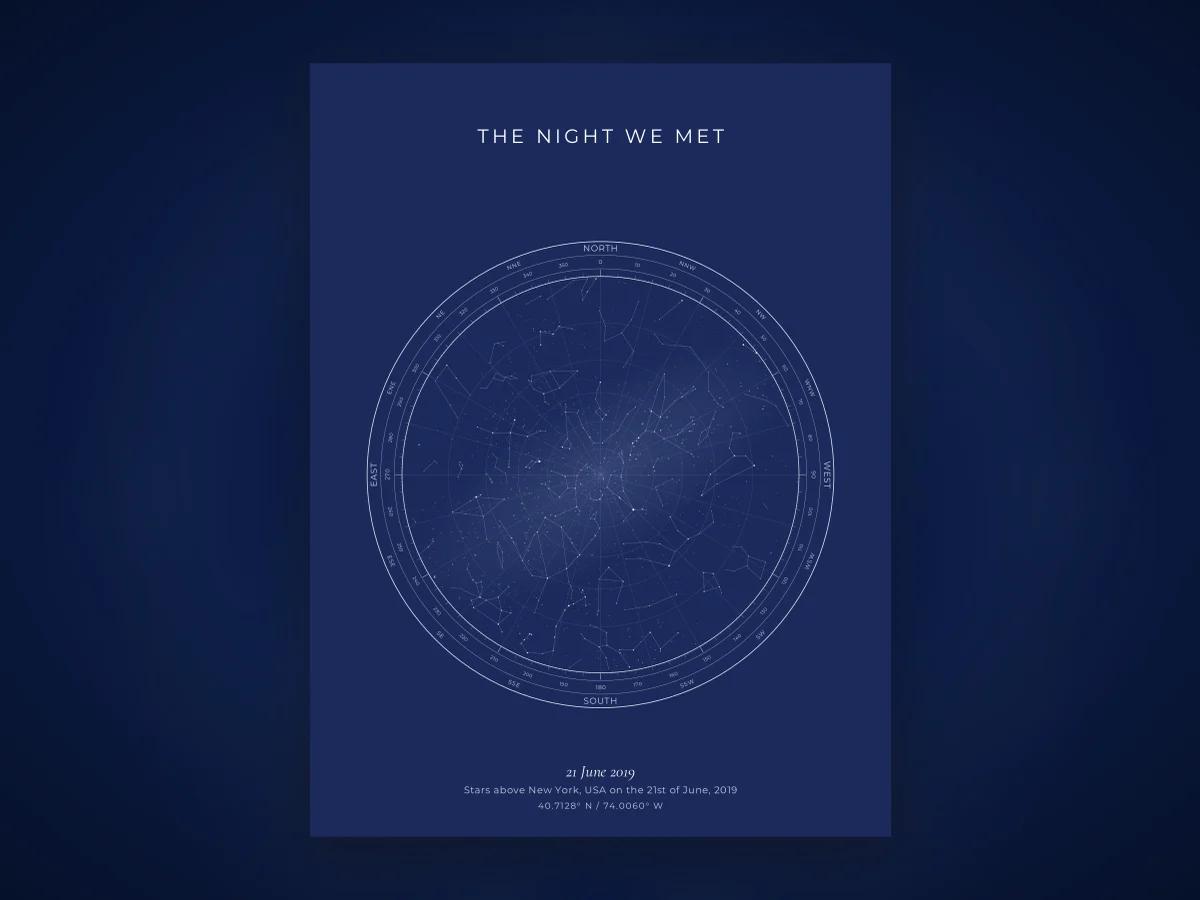
- Stars: about 9,000, every star to magnitude 6.5, roughly the naked-eye limit under a dark sky, from the HYG catalog, each drawn at its computed position for your date, time and place, and sized by brightness.
- Constellations: all 88 IAU constellations that are above the horizon at the moment, as line figures, with names on a toggle.
- The Milky Way: as a soft band, on a toggle.
- The horizon and compass ring: a 16-point ring with degree ticks, and an altitude and azimuth grid inside it, together on a toggle.
- Text: your title, subtitle, place, date and coordinates.
Not included: the Sun, the Moon, the planets, individual star names, deep-sky objects, comets, meteors, satellites. Some designs carry a moon graphic; it is a design element and does not represent the Moon's real position or phase. Dates from 1900 to 2100 are supported; the accuracy page explains why the range stops there.
If the Moon was part of your night
If a full Moon over the reception or a bright Venus over the hospital car park is part of what you want to remember, you have two good options. Choose a maker who plots them. Or use a fixed star map and put the memory into the words: "Under a full Moon" as a subtitle costs nothing and is as accurate as anything drawn. Check the phase and the planets for your date in a planetarium app first, so the words are right, and then let the stars, which were there too and which do not change, carry the rest.
For the related question of what a birth sky contains and leaves out, the guide to what the sky looked like on your birthday covers it season by season, and the new baby page shows how people have set the text for a birth, in designs like moon that suit the subject.
Frequently asked questions
Do custom star maps show the planets?
Most do not, including ours. Planets move against the background stars over weeks and months, and most star map makers plot only the fixed stars and constellations. A few makers do compute and draw the planets for the chosen moment. If it matters to you, check the maker's sample maps or accuracy page before ordering.
Does a star map show the Moon and its phase?
Usually not. The Moon moves about 13 degrees a day against the stars and changes phase nightly, so it is left off most fixed star maps. Some of our designs include a moon graphic, but it is decorative and does not show the Moon's real position or phase. Makers who plot the Moon will say so explicitly.
Why do star maps leave the Moon and planets out if they can be calculated?
They can be calculated; the choice is about what the map is for. A star map is a portrait of the fixed sky over a moment. The Moon at its true size would be a speck; drawn large enough to recognise it would hide stars. Planets add clutter to a picture that is meant to read as a constellation chart. Some makers make the opposite choice, and both are legitimate as long as they are honest.
Is the Milky Way on a star map?
Often, yes. Unlike the Moon and planets, the Milky Way is fixed among the stars, so its position for any moment is exact. Ours draws it as a soft band that can be switched on or off. Its shape on paper is an approximation of something diffuse.
How can I tell what a maker actually includes?
Read the accuracy or how-it-works page, look closely at a sample for a known date, and if possible preview a date when a bright planet was high in the evening sky and compare with a planetarium app. If the preview shows only stars where Jupiter should be, the maker plots only stars.