
 by
by What Did the Sky Look Like the Night I Was Born? (How to Find Out)
Somewhere there is a record of the minute you arrived, and above that minute there was a sky. It was not a remarkable sky in any astronomical sense. It was the ordinary sky of that season, seen from that latitude, turned to that hour. But it was the only one that ever stood over that exact event, and it can be reconstructed precisely.
This guide walks through how. It covers what determines the sky at any given moment, how to track down the birth time and place you need, which free tools compute it, what a star map will show you and what it honestly cannot, and how to turn the result into something on a wall.
What decides what the sky looked like
Three inputs fix the night sky for any moment. Everything else follows from them.
The date
Earth circles the Sun once a year. On any given night you look out from the side of Earth facing away from the Sun, into whichever part of the sky is opposite it. That part changes steadily through the year, which is why Orion belongs to northern winter evenings and Scorpius to northern summer ones. Neither goes anywhere; they simply take turns being on the night side.
The change is gradual, about four minutes a night, so a birth in early June and a birth in late June share most of the same stars. Across three months, though, the evening sky turns through a full quarter and the cast changes almost completely.
The time
Earth also turns once a day, carrying the whole sky from east to west at roughly 15 degrees an hour. The constellations up at 9 p.m. are not the ones up at 4 a.m. The pre-dawn sky, in fact, previews the evening sky of several months later.
This is why birth time matters to a star map. It does not change which season's stars were around; it changes which of them were high overhead, which were rising, and which had already set. A map for 3 a.m. and a map for 9 p.m. on the same date are recognisably different pictures.
The place
Latitude decides which stars you can see at all. From the equator every star rises and sets in turn. From 50 degrees north, the stars around the north celestial pole never set, and the stars deep in the southern sky never rise. Someone born in Oslo never had the Southern Cross in their birth sky; someone born in Cape Town never had the Big Dipper high overhead.
The hemisphere also flips the picture. The same constellation, seen from Sydney and from Seattle, appears upside down relative to the other view. Longitude matters mainly through the time zone, which turns your local clock time into the universal time astronomers actually compute with.
If you would like a longer treatment of these three factors, the companion article on what the sky looked like on your birthday goes season by season.
Finding your birth time
You may already know it. If not, here is where it tends to be recorded, roughly in order of how likely it is to succeed.
Your birth certificate, but check which one
In the United States there are usually two versions. The short-form or abstract certificate, the one most people have in a drawer, often shows only the date. The long-form, sometimes called the vault copy or certified copy of the original, generally includes the time of birth, the hospital, and the attending physician. You can request it from the vital records office of the state where you were born, usually for a modest fee.
Practice varies elsewhere. In England and Wales, time of birth is recorded on the certificate only for multiple births, so twins have it and singletons usually do not. Many countries in continental Europe and Latin America record the time as standard. If your certificate is silent, do not conclude the information is lost; it may simply be in a different document.
Hospital records
Hospitals keep birth records, though retention periods vary and older records may have been archived or destroyed. A written request to the medical records department, with your full name at birth, date of birth and mother's name, is the usual route. Expect it to take weeks rather than days.
Family sources
Baby books, birth announcement cards, the note pinned in a photo album, and the memory of whoever was in the room. Parents often remember the hour with surprising precision, or remember something that pins it down: the shift change, the sunrise, the late-night drive.
If the time cannot be found
Choose an hour deliberately rather than leaving it to a default. Most people pick an evening time, around 10 p.m., because it gives a sky someone could have stepped outside and seen. Others pick midnight for the symbolism. Either is honest as long as the map's text does not claim a precision you do not have. Leave the exact time off the subtitle and give the date and place.
Finding the place
City-level is enough for a naked-eye star map. The difference between a hospital and a house across town is invisible at this scale; the difference between two cities in different time zones is not. What you need is the town and the country, and to be sure the tool you use resolves the historical time zone correctly.
That last point occasionally trips people up. Time zones and daylight-saving rules have changed over the decades. A birth in 1974 in the United States, for instance, fell during a period of year-round daylight time. A good tool applies the rules in force on the actual date; a careless one applies today's rules to a date decades ago and shifts the sky by an hour.
The tools that reconstruct the sky
Two are worth knowing about, one for exploring and one for making something.
Stellarium Web
Stellarium Web is a free planetarium that runs in the browser. Set your location, then set the date and time, and it draws the sky as it would have appeared, including the Moon, the planets, and the Milky Way. You can drag around, zoom in, and switch constellation art and labels on and off. It is the right tool for the question "what was up that night?" in full, because it shows the moving bodies as well as the fixed stars.
Its limitation is that it is an exploring tool, not a printing tool. Screenshots are fine for curiosity and awkward for a wall.
A star map designer
Our designer computes the same star positions for your date, time and place, using local sidereal time and the standard coordinate transforms, and lays them out as a print. The preview is free and renders in the browser as you type, so you can check the sky before deciding anything. If you go on to a print or a file, the digital version is $25 and framed prints run $69 to $179. That is the only product mention in this article; the rest is astronomy.
Whichever tool you use, the underlying computation should be the same: fixed-star positions from a catalog, precessed and rotated to your moment. The accuracy page explains ours, including the catalog (HYG, roughly 9,000 stars to magnitude 6.5), the 88 IAU constellations, and the 1900 to 2100 date range we support.
What you will see, and what you will not
Here the honest part matters, because a star map is a specific kind of picture and it is easy to expect more from it than it contains.
You will see the fixed stars and the constellations
Every star visible to the naked eye under a dark sky, sized by brightness, in its correct position for your moment, with the constellation figures drawn through them. The horizon is the circle's edge; the point straight overhead is the centre. If the Milky Way was arching over the hospital, a good map draws it as a soft band, because the Milky Way, like the stars, is fixed on the celestial sphere.
You will usually not see the Moon or the planets
This surprises people, so it is worth being direct. The Moon and the planets are not fixed. The Moon moves roughly 13 degrees against the stars every day, about the width of a fist at arm's length; the planets drift through the zodiac constellations over weeks and months. Most star maps, including ours, plot only the fixed sky and leave the wanderers out. Some makers do include them, drawn as symbols at their computed positions. If a full Moon or a bright Venus over the delivery room is part of the story, check it in Stellarium and consider recording it in the map's text.
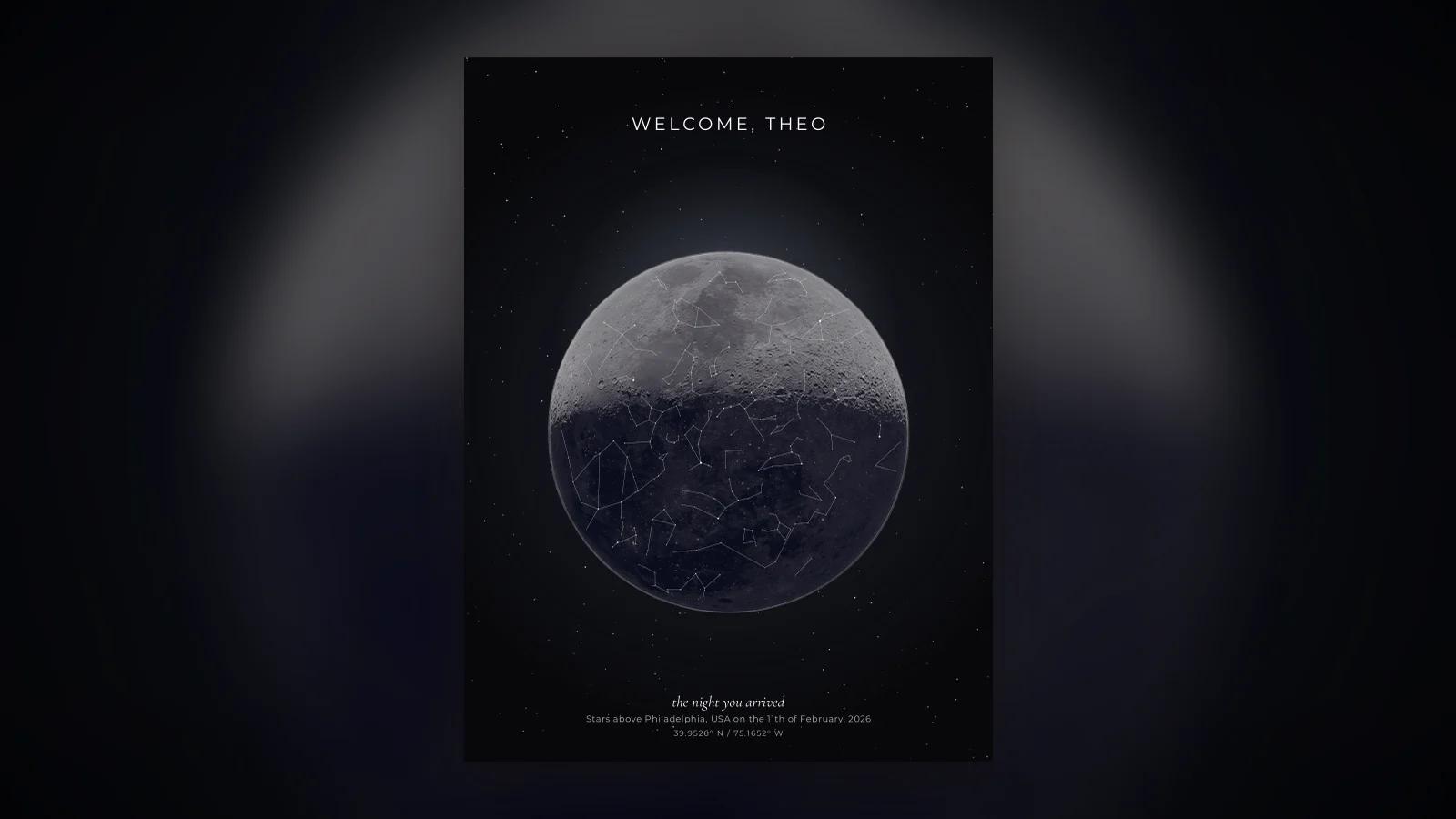
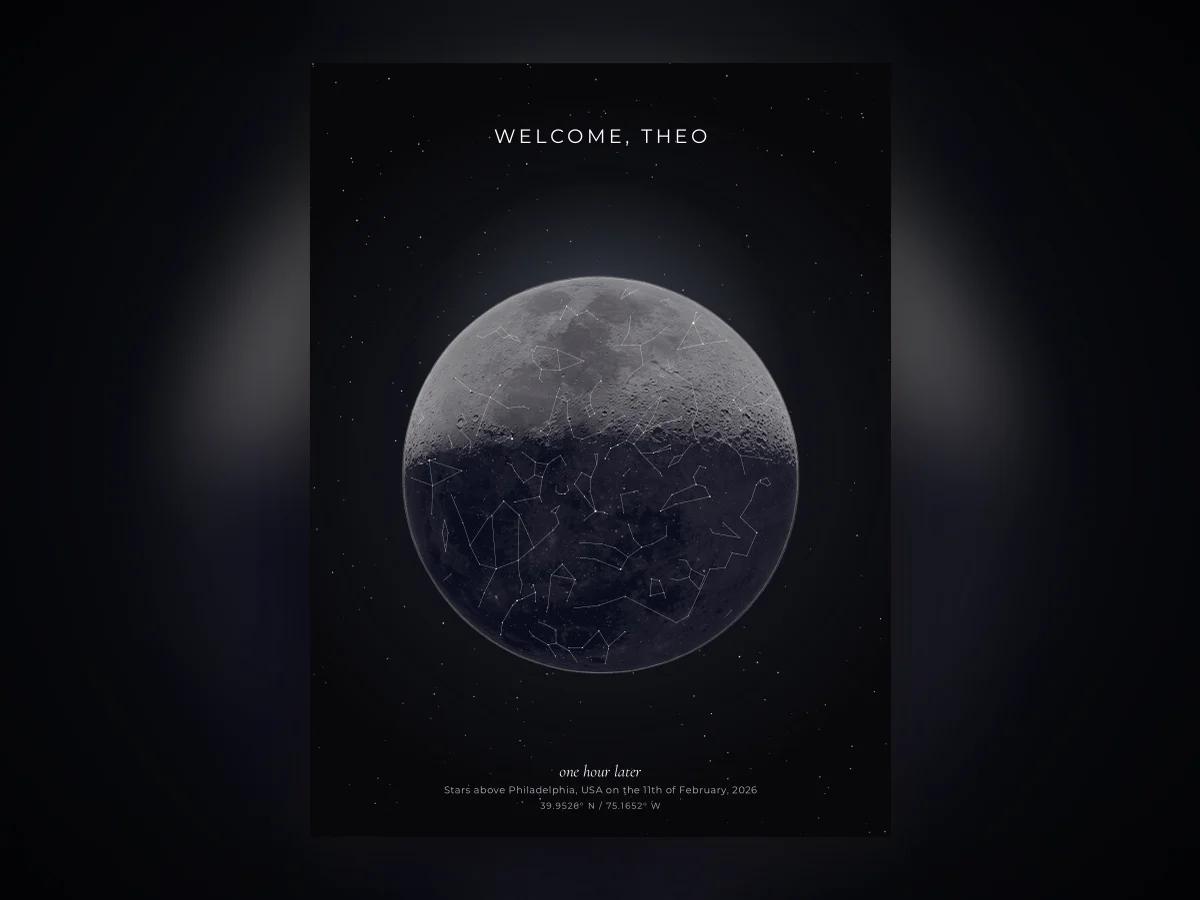
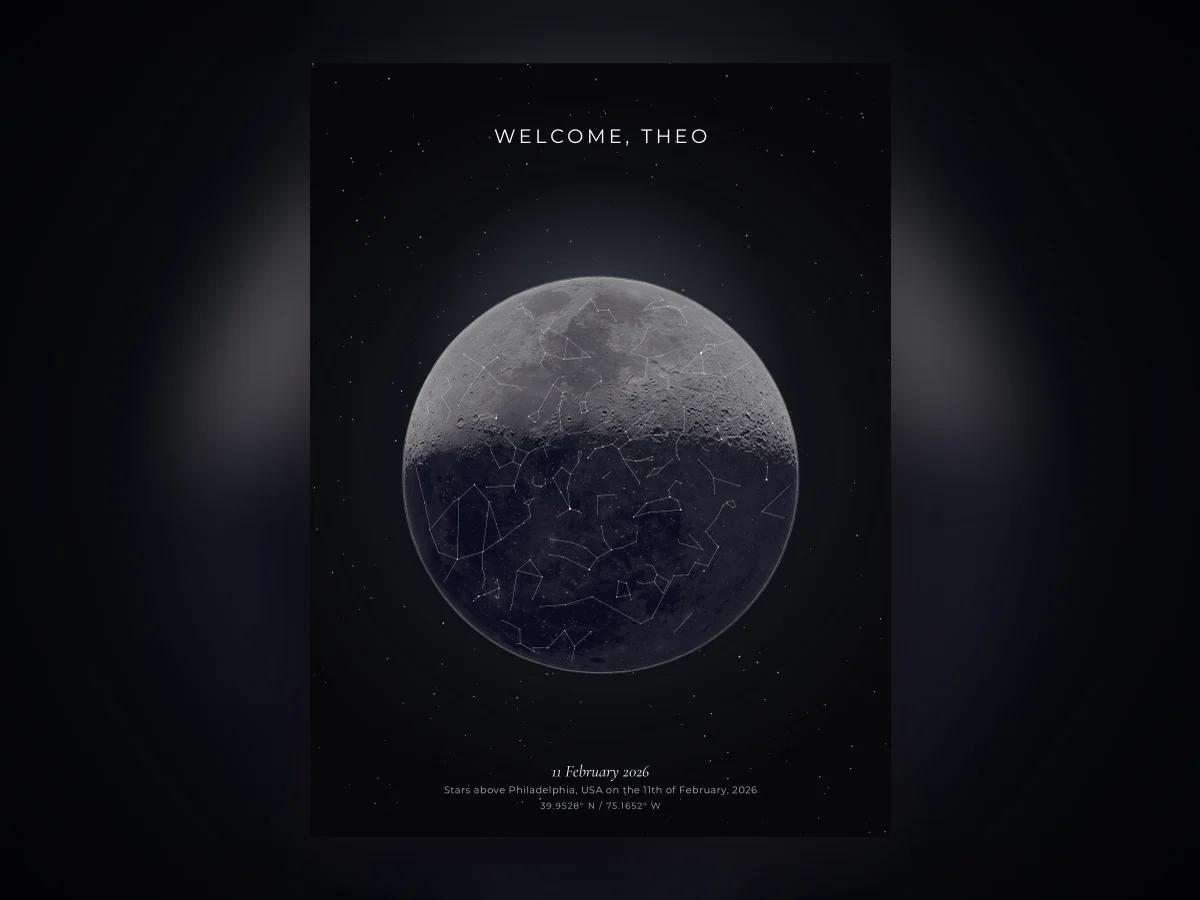
A related point: some of our designs include a decorative moon graphic. It is a design element, not the Moon's real position or phase that night.
Daytime births
If you were born at 11 a.m., the stars were still there, above the blue. A map for that minute shows them, which some people find more moving rather than less: a sky nobody saw, that was there anyway. The Sun itself is not plotted, for the same reason the Moon is not.
The tiny caveats
The stars do move on their own, very slowly, and Earth's axis wobbles over about 26,000 years. Within a human lifetime the shift is about a degree, two Moon widths, and a good map accounts for it. Over centuries it becomes noticeable, which is why honest makers state a date range rather than pretending any year is equally reliable.
Making it into something
Once you have seen the sky, the question is what to do with it. A few practical notes.
Choose the hour with care. If you know the birth time, use it; the map is then a record. If you do not, choose an evening hour and say so in the subtitle, or leave the time off.
Decide what the text should carry. Name, date, place, and coordinates are the usual set. Some people add the time; some add a line only they will understand. Restraint tends to age well.
Print on matte paper. Dark backgrounds show fingerprints and glare on gloss. A 300 DPI file at 12 by 16 inches or larger keeps the smallest stars crisp.
For a child's birth sky, the same map works as nursery art and, later, as something they take with them. The new baby and birthday pages have examples of how people have set the text for those occasions.
The sky over your first minute was not arranged for you. It was simply there, exactly as it was, and it can be drawn again. That is a quieter claim than the horoscope makes, and a truer one.
Frequently asked questions
How do I find out what the sky looked like the night I was born?
You need three things, the date, the time, and the place, then a tool that computes star positions for that moment. Stellarium Web is free and lets you set any date, time and location. Our designer at thestarmoment.com/create does the same in a printable layout. Both compute the sky from the same underlying astronomy.
Where can I find my exact birth time?
In the United States, the long-form or vault copy of your birth certificate usually records the time; the short-form often does not. Hospital records, a baby book, and your parents are the other common sources. In the UK, time of birth is generally recorded only for multiple births, so hospital notes are the better route.
Does it matter if I do not know my birth time?
Less than you might think. The date sets which constellations are up at all, and the time only shifts where in the sky they sit. A few hours either way keeps the same season of stars. If the time is unknown, most people choose an evening hour so the map shows a sky someone could have stood outside and seen.
Will a star map show the Moon and planets that night?
Usually not. The Moon and planets move against the stars, so most fixed star maps, including ours, plot only stars and constellations. If a bright planet or a full Moon was up that night, check it in a planetarium app and, if it matters to you, mention it in the map's subtitle.
Can I make a star map for a daytime birth?
Yes. The stars are above you in daylight; the Sun simply outshines them. A map for a daytime birth shows the stars that were overhead at that minute, which nobody on the ground could see but which were there all the same.