
 by
by Memorial Gift Ideas That Are Gentle, Not Generic
Grief does not follow a schedule, and most memorial gifts are chosen too quickly, in the narrow window right after a death when a family is already overwhelmed by casseroles, flower arrangements, and other people's discomfort with silence. A gift given later, once that first wave has passed and the house has gone quiet again, is often received more fully than anything offered in the first week.
This guide sets out ideas that name the specific person rather than grief as a general category, along with notes on timing, etiquette, and what tends not to help. Nothing here should be read as encouragement to act quickly, and there is no gift on this list that carries any expectation of being purchased at all.
What actually helps, and what doesn't
A memorial gift works best when it is specific to the person who died: a date, a place, a phrase they used, a habit only their own life would have produced. Generic sympathy items, a candle printed with a borrowed sentiment, a decorative sign with no name on it, are easy to buy in a hurry and rarely remembered afterward. The families who mention a particular gift years later are almost always describing something that referred to their specific person, not to loss in the abstract.
Timing matters as much as the object itself. In the first days after a death, practical help, a meal left at the door, an errand run without being asked, childcare arranged quietly, usually matters more than any keepsake. A reflective gift tends to land better later, once the immediate demands have eased and the family has some distance from the funeral itself. If you are unsure whether now is the right moment, it is almost always acceptable to wait.
Keepsakes tied to that specific person
A star map of a date that mattered to them
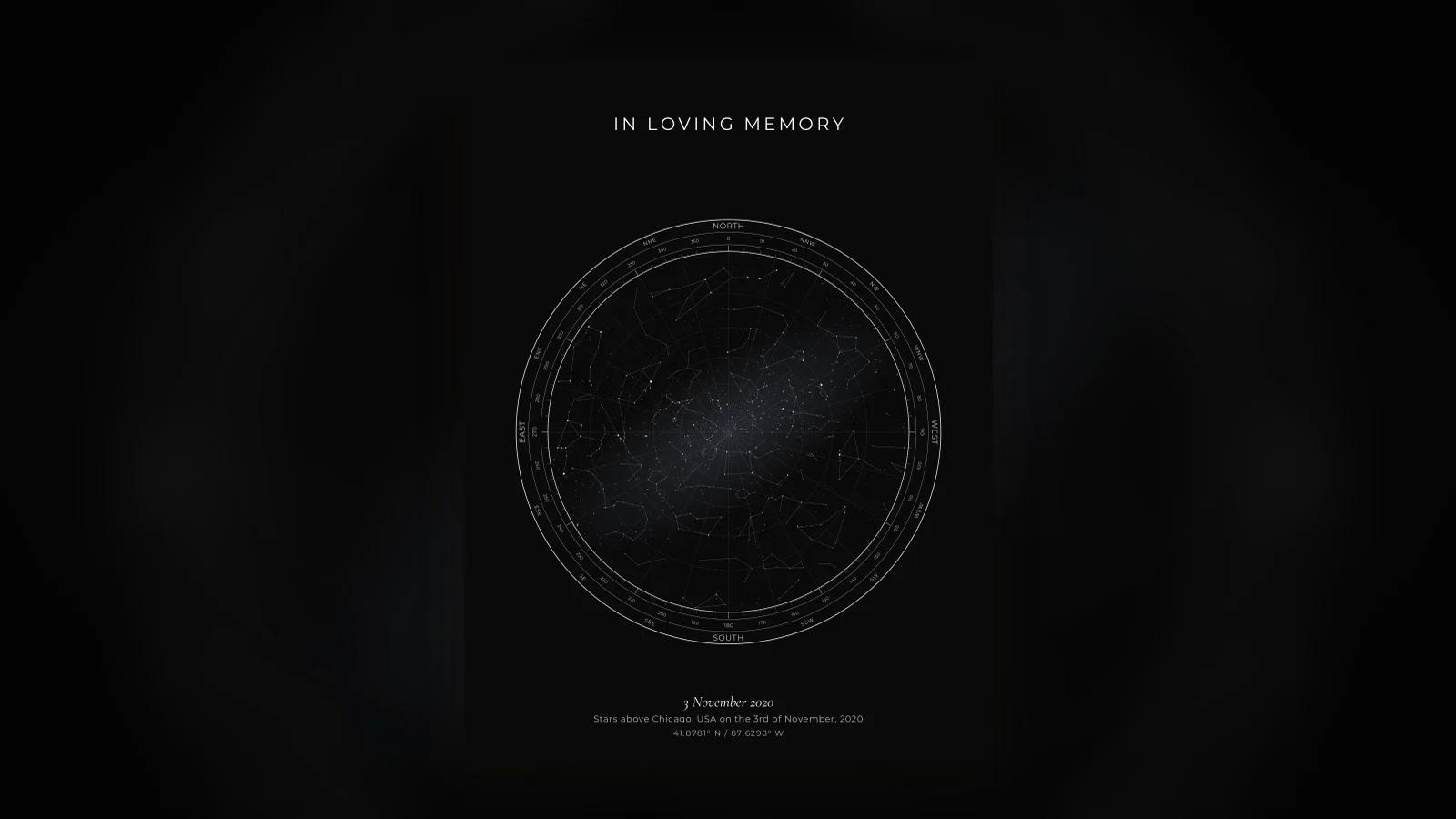
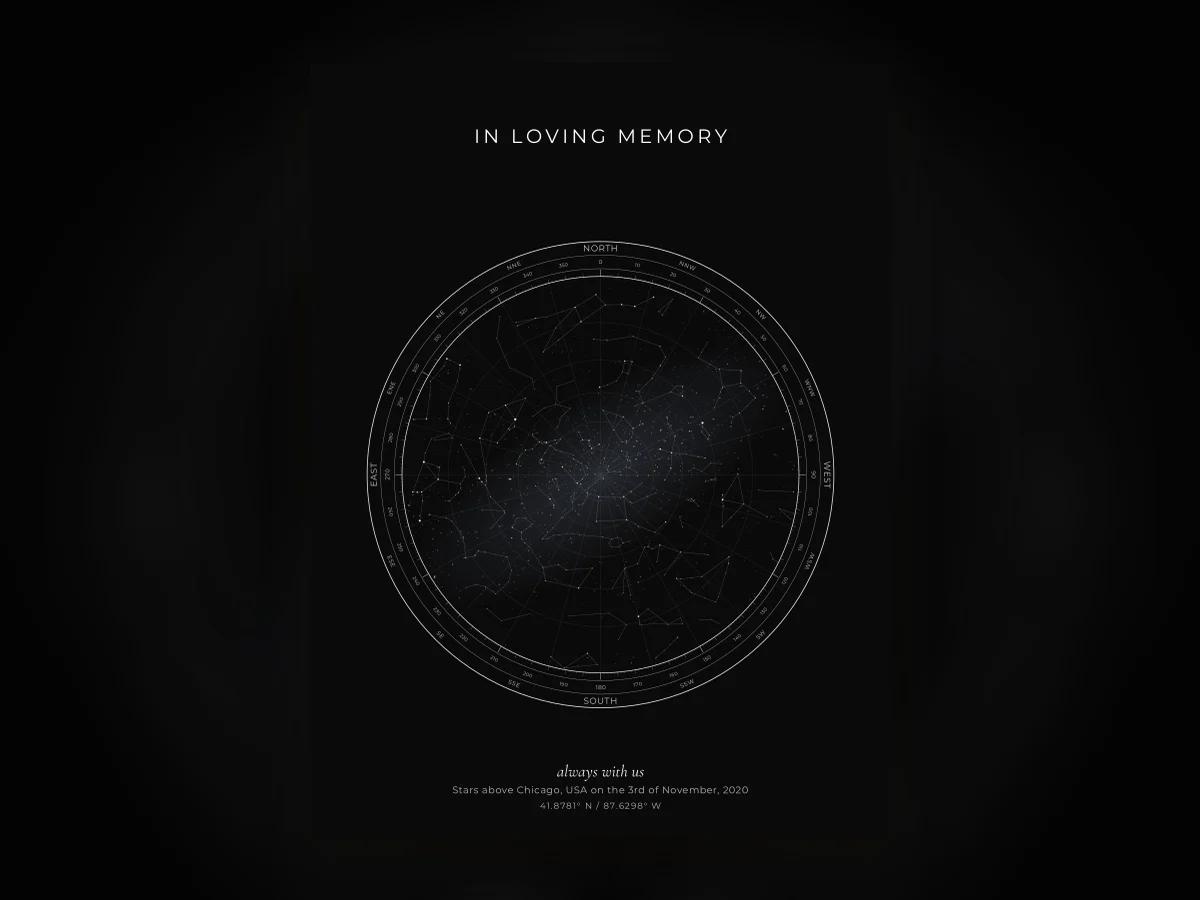
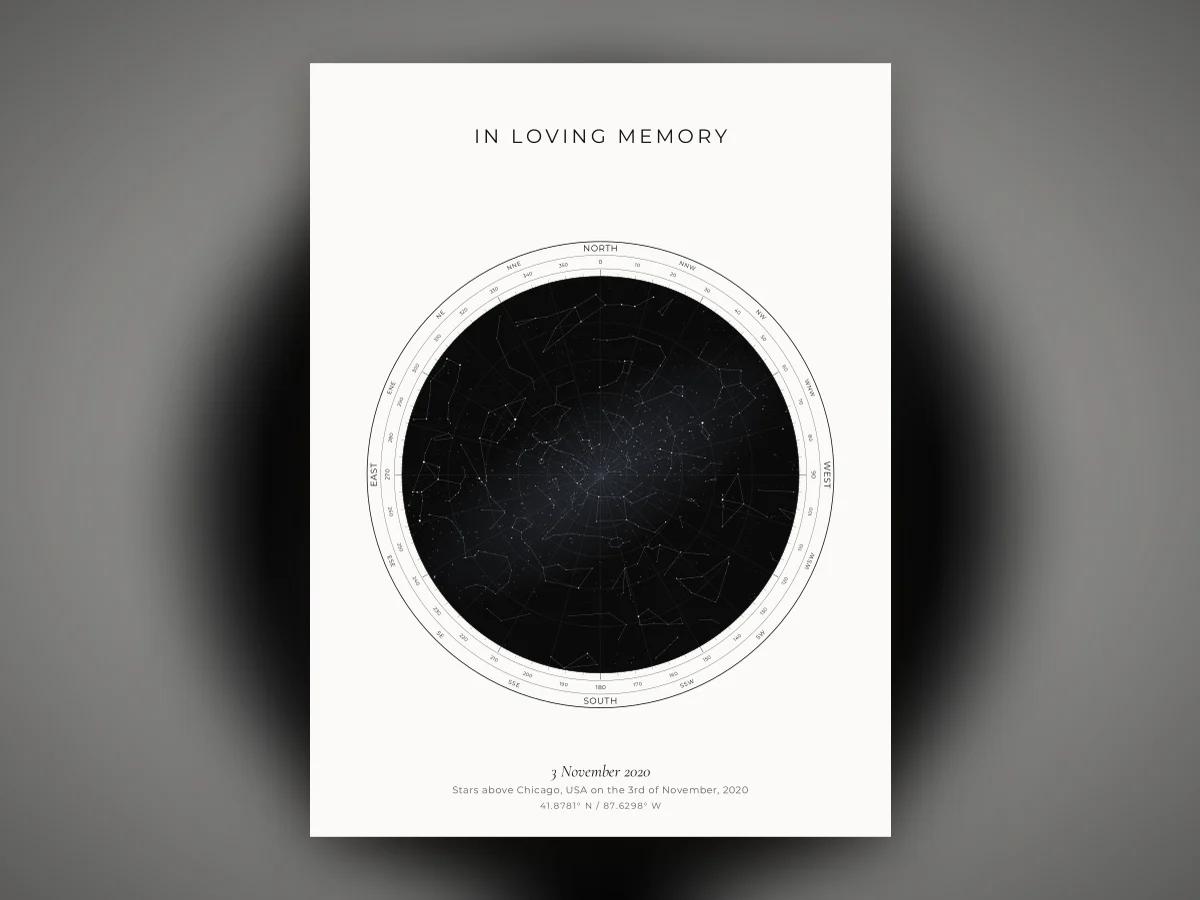
The sky as it stood over a specific place on a specific date, a birth, a wedding, the day they died, held quietly rather than displayed prominently unless the family chooses otherwise. It suits a family that finds comfort in something tangible and precise, and it is not the right choice for a family that would rather not manage any new object while grieving. See the memorial star map page, which explains how the design is kept deliberately restrained, in the noir or black disc styles rather than anything bright or decorative. Digital files are $25; framed prints are $69 to $179 with free shipping to the US and 40+ countries, for a family that wants something physical to keep. The accuracy page sets out exactly how the date and place are computed, for anyone who would rather understand that before considering it at all.
A framed photograph, chosen with care
Not necessarily the most posed or formal photo, but one that captures something true about them. Ask a close family member which photograph they would choose themselves, rather than deciding alone on their behalf.
A donation made in their name
To a cause they cared about while alive, made quietly and mentioned simply, without any expectation of acknowledgement or thanks. Many families find this more comfortable than a gift addressed to them personally, since it directs attention back to the person who died.
A planted tree, or a marker in a memorial garden
For a family with a garden, or access to a local memorial planting programme, something living that continues to grow is a different kind of keepsake than an object that simply sits still on a shelf.
A written collection of memories from people who knew them
Ask a small number of people who knew the person, colleagues, old friends, distant relatives, to each write a short, specific memory, and compile them simply without embellishment. This becomes something the family can return to slowly, over years, in their own time and at their own pace, rather than something to read once and set aside.
A recording of their voice, preserved properly
If voicemails, videos, or recordings exist, offer to help transfer them to a format that will still be accessible in ten years. Formats change quietly and without warning; a voice saved only on an old phone can become unreachable long before anyone expects to lose it.
For a spouse or a parent
The person closest to the loss usually needs something different from what a wider circle of friends can offer. A spouse or a parent is often navigating decisions, paperwork, and a home that has changed shape, on top of grief itself. A keepsake for this person carries more weight than for a wider circle, and less urgency helps here more than anywhere else; there is rarely a "right time" to hand over something reflective to someone still managing the practical aftermath of a death.
If you do choose an object for a spouse or parent specifically, consider one that can be kept privately at first, a small framed print for a bedside table rather than a large piece for a shared wall, since the pace of what they are ready to display publicly may take longer than you expect, and that is not a sign the gift was wrong.
For children and siblings
Children and adult siblings are often the least considered in the wider circle of sympathy, since attention naturally moves toward whoever was closest to the person who died, a spouse, a parent. A sibling can carry a lifetime of shared history with almost nobody checking in on them directly, and a child who has lost a parent or a grandparent often has fewer places to put a feeling this large.
For a grieving child, a simple, concrete keepsake, a photograph they chose themselves, a small object that belonged to the person, tends to work better than an abstract explanation of loss. For an adult sibling, direct acknowledgement that their grief is real and separate from anyone else's, rather than secondary to a parent's or a spouse's, is often the thing nobody has said to them yet.
For colleagues and a wider circle
If you knew the person less closely, through work, through a shared activity, through a mutual friend, a smaller and simpler gesture is usually more appropriate than an elaborate keepsake, which can feel presumptuous from someone outside the immediate family. A card with a specific, genuine memory, a contribution to a cause in their name, or a small collective gesture organised with colleagues, a meal delivered, a fund toward the funeral costs, tends to be both welcome and appropriately scaled to the relationship.
It is also worth asking, quietly and without pressure, whether the family would prefer flowers, donations, or nothing at all, since preferences vary and are sometimes stated in an obituary or by whoever is coordinating on the family's behalf.
Sympathy etiquette worth knowing
A short, sincere note is rarely wrong, and a long one is not required to be meaningful. Naming something specific about the person who died, a memory, a quality, a kindness they showed you, matters more than the length of what you write. Avoid phrases that suggest a timeline ("they're in a better place now," "time heals," "at least they're not suffering anymore"); however well intended, these can land as a request to feel better on someone else's schedule.
It is generally kinder to say less and mean it than to fill a silence with something that sounds comforting but says nothing true. If you do not know what to say, "I don't have the right words, but I'm thinking of you" is honest and rarely unwelcome.
Quiet ways to help, beyond an object
Offer a specific form of ongoing support rather than a single gift: checking in on a set day each month through the first year, handling a recurring task they no longer have capacity for, sitting with them without needing to talk. If you are close to the family, your continued presence weeks and months after the funeral, once most other support has quietly ended, is often the most valued gift of all, and it costs nothing.
Anniversaries and remembrance days
The anniversary of a death, and sometimes the person's birthday, can be harder than the day of the funeral itself, once the initial wave of attention has receded and the person is often grieving more alone than before. A short note, a phone call at a time that suits them, or simply acknowledging the date without requiring a response can matter more on these days than on any other.
What to avoid
Avoid anything that implies a timeline for grieving, gifts that require the person to do something with them immediately, and generic mass-produced sympathy items with no connection to the specific person who died. Avoid surprising someone with a gift in front of others if you are unsure how they will react, and avoid framing any gift as a way to help them "move forward," a phrase that assumes a destination grief does not actually have.
When grief needs more than a gift
No object, however well chosen, replaces support from people trained to help with grief. If someone you care about seems to be struggling well beyond what feels manageable, or if you are the one grieving and finding it hard to function, a grief counsellor, a support group, or a family doctor are reasonable places to ask, and asking is not a sign that the grief itself is unusual or wrong. A gift can sit alongside that kind of support; it is not a substitute for it, and nothing in this guide should be read as suggesting otherwise.
A note on pet loss
The loss of a pet is a different grief, but it is not a smaller one, and it deserves the same care described here. Our separate guide on pet memorial gifts covers that loss specifically.
A note on this page
Nothing here should be read as encouragement to act quickly, or as a suggestion that any particular gift is expected. If a star map feels right for your family, at whatever pace feels right to you, the designer is available to look at, with no obligation and no time limit attached to it.
Frequently asked questions
What is a thoughtful memorial gift for someone who is grieving?
Something specific to the person who died, rather than a generic sympathy item. A keepsake naming a date or a place that mattered to them, a practical form of help in the weeks after the funeral, or simply your continued presence weeks after the immediate support fades all tend to be received well. What matters is that it reflects the actual person, not grief as an abstract category.
Is it appropriate to give a gift for a death anniversary?
Many families welcome an acknowledgement on the anniversary of a death, particularly a small, quiet gesture rather than a large or festive one. A short note, a phone call at a time that suits them, or a modest keepsake usually reads better than something elaborate or public.
What should you avoid giving someone who is grieving?
Avoid anything that implies the grief should be resolving on a schedule, generic phrases printed on mass-produced items, and gifts that require the grieving person to do anything with them right away. Avoid surprising them in front of others, and avoid framing the gift as a way to "move forward." Simplicity and sincerity matter more than the item itself.
Is a star map an appropriate memorial gift?
It can be, for a family that would find comfort in the sky from a specific date, a birth, a wedding, or the day someone died, kept as a private, dignified keepsake rather than a display piece. It is not right for every family, and it should never be offered with pressure or urgency. Digital files are $25; framed prints are $69 to $179 with free shipping to the US and 40+ countries, for a family that wants a physical object to keep.
How soon after a death should you give a memorial gift?
There is no fixed timing, and no wrong time within reason. Immediately after the death, practical help is usually more useful than a keepsake. A memorial gift often lands better weeks or months later, once the initial support from others has faded and the person has more capacity to receive something reflective.