
 by
by What Did the Sky Look Like on My Birthday? (How to See It)

The stars over the hospital on the night you were born were not special in any cosmic sense. They were the ordinary stars of that season, seen from that latitude, at that hour. What makes them yours is that no one else's birth happened under exactly that arrangement from exactly that place at exactly that minute.
This guide explains what your birthday sky actually contained, why it looked the way it did, what a star map can and cannot show you, and how to see it yourself for free before you decide whether to print it.
Why the sky on your birthday is different from someone else's
Three things set the night sky for any given moment: the date, the time of night, and where on Earth you stood.
The date decides the season's stars
Earth goes around the Sun once a year. At night, you face away from the Sun and out into whichever part of the sky happens to be opposite it. In January the night side of Earth faces toward Orion and Taurus; six months later it faces toward Scorpius and Sagittarius, which were behind the Sun in January and invisible.
That is why constellations belong to seasons. Orion is a winter figure in the northern hemisphere not because it goes anywhere, but because in summer it is up during the day, lost in sunlight.
The shift is gradual. Each night, any given star rises about four minutes earlier than the night before. Over a month that adds up to two hours; over a year it comes back around. So someone born in early March and someone born in late April share most of the same constellations, but the April sky at 10 p.m. looks like the March sky at midnight.
The hour decides what is high and what is low
Earth also turns once a day, which carries the whole sky from east to west at about 15 degrees per hour. A constellation that is climbing in the east at 8 p.m. is high overhead by midnight and sinking in the west before dawn.
This is why the birth time matters to a star map. The same date at 6 a.m. shows a very different overhead sky than at 9 p.m.; the pre-dawn sky in fact previews the evening constellations of the months ahead. If you know your birth hour, use it. If you do not, the section on choosing a time below has suggestions.
Your latitude decides which stars you can see at all
Stand at the North Pole and Polaris sits directly overhead; the southern stars never rise. Stand on the equator and every star rises and sets in turn. In between, your latitude sets how high the celestial pole sits above the horizon and which stars stay hidden below it.
Someone born in Edinburgh never had Crux, the Southern Cross, in their birthday sky. Someone born in Melbourne never had the Big Dipper high overhead. Two babies born the same minute in Toronto and in Buenos Aires had almost entirely different skies, and the constellations they shared appeared upside down relative to each other.
Longitude matters too, but only through the time zone: it determines what "10 p.m. local" means in universal time, and a star map handles that automatically once it knows the place.
What your birthday sky contains
Under a dark sky, far from city lights, a person with ordinary eyesight can see stars down to about the sixth magnitude. Across the whole celestial sphere that is roughly 9,000 stars, and about half of them are above the horizon at any moment. Most people have never seen that many because most people live under some light pollution, but they were there.
Your birthday sky, then, had:
- The season's constellations, some high, some near the horizon, according to the hour.
- The circumpolar stars, which never set from your latitude. From mid-northern latitudes these include the Big Dipper in Ursa Major, Cassiopeia, Cepheus, Draco and Polaris in Ursa Minor; from mid-southern latitudes, Crux and the Centaurus pointers stay up most nights.
- The Milky Way, if the season and hour put it well above the horizon. Its brightest stretch, toward the center of the galaxy in Sagittarius and Scorpius, is a summer evening sight in the northern hemisphere. Its fainter arm runs through Cassiopeia, Perseus, Auriga and past Orion in the autumn and winter evening sky. On spring evenings you look out of the galactic plane, toward Leo and Virgo, and the band lies along the horizon where it is hard to see.
- A few thousand fainter stars you could never have picked out individually but which give the sky its texture.
What it did not contain, as far as a star map is concerned
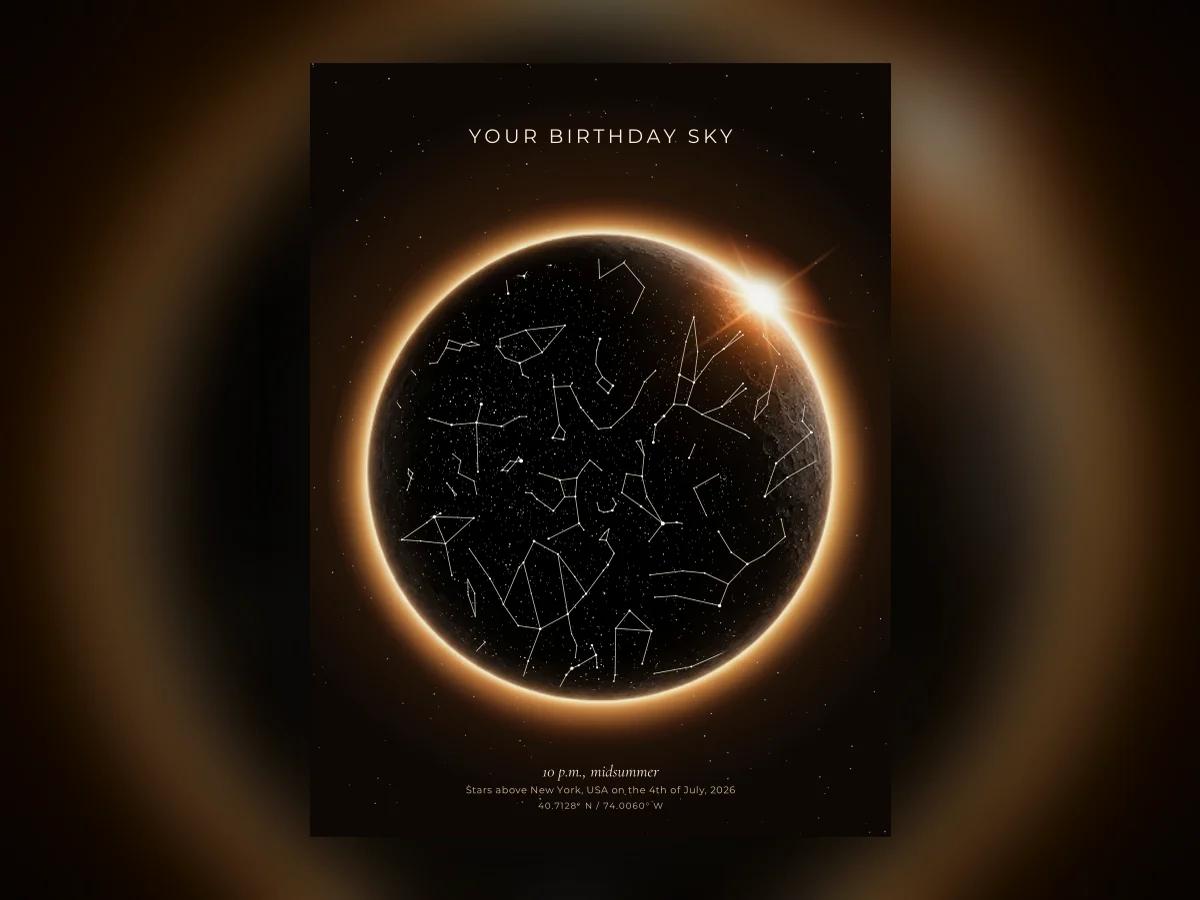
The Moon and the planets are part of the real sky but they are wanderers. They move against the background stars from night to night, and the Moon changes phase and position dramatically within a single week. A star map is a map of the fixed stars for a given moment, and most makers, including The Star Moment, do not plot the Moon or planets. Some of our designs include a decorative moon graphic; it is an illustration, not the Moon's actual position or phase on your date.
If you specifically want to know where the Moon was or which planets were visible on your birthday, a planetarium program will tell you, and we point to a free one below. Do not assume a printed star map includes them unless the maker says so plainly.
Why the same date shows the same stars every year, but not the same Moon
If you go outside at 10 p.m. on your birthday this year, you will see almost exactly the stars that were up at 10 p.m. on the night you were born. This surprises people who expect the sky to have moved on.
The reason is that our calendar is built to keep in step with the seasons, and the seasons are set by Earth's position in its orbit, which is what decides the night-time stars. The stars' return to the same evening position (the sidereal year) and the calendar's tropical year differ by only about twenty minutes. Leap days keep the calendar aligned with the orbit, and the stars come along for the ride.
There is one slow drift. Earth's axis wobbles like a spinning top over a cycle of roughly 26,000 years, a motion called precession. It shifts the star positions relative to the calendar by about one degree every 72 years, which over a human lifetime is roughly the width of two full Moons. You would not notice it by eye. A properly computed star map accounts for it, which is one reason to prefer a maker who states a supported date range and explains the method, as our accuracy page does.
The Moon does not cooperate. Its cycle of phases takes about 29.5 days, which does not divide evenly into a year, so its phase on your birthday changes every year and only comes back close to the same phase roughly every 19 years. The planets each move at their own pace. So the stars on your birthday are constant; the Moon and planets are new every year.
What is overhead at 10 p.m., season by season
This guide is for the northern mid-latitudes, roughly the continental United States, Canada, Europe and Japan. Each list describes the evening sky near the middle of the season; at the start of a season the next season's stars are still rising in the east, and at the end the previous season's are setting in the west. Southern hemisphere readers see a different sky, and even shared constellations appear flipped.
Winter birthdays (December to February)
The richest evening sky of the year. Orion stands high in the south, its three belt stars in a short straight line, with red Betelgeuse at one shoulder and blue-white Rigel at the opposite foot. Follow the belt up and to the right to Taurus, with orange Aldebaran and the small tight cluster of the Pleiades. Follow it down and to the left to Sirius in Canis Major, the brightest star in the night sky. Gemini stands above Orion, its twin bright stars Castor and Pollux side by side. Capella in Auriga is nearly overhead. The fainter winter arm of the Milky Way runs through this whole region.
Spring birthdays (March to May)
A quieter, more open sky. Leo is high in the south, recognizable by the backwards question mark of stars that forms its head and the bright star Regulus at the base. The Big Dipper is at its highest, nearly overhead; follow the curve of its handle to bright orange Arcturus in Boötes, and continue the arc to Spica in Virgo. The winter constellations are setting in the west. With the Milky Way lying along the horizon, spring skies show fewer bright stars but a clear window out of our galaxy.
Summer birthdays (June to August)
Three bright stars high overhead form the Summer Triangle: Vega in Lyra, Deneb in Cygnus and Altair in Aquila. Cygnus stretches along the Milky Way like a cross, and from a dark site the band of the galaxy runs from it down to the southern horizon. Low in the south, Scorpius curls its tail above the horizon with red Antares at its heart, and next to it Sagittarius marks the direction of the galactic center. Because summer nights are short and twilight lingers at higher latitudes, 10 p.m. in June may not be fully dark.
Autumn birthdays (September to November)
The Great Square of Pegasus rides high in the south, four moderately bright stars framing an area with surprisingly few others. Attached to one corner, Andromeda extends toward the northeast, and from a dark site you can see the faint oval smudge of the Andromeda Galaxy, the most distant thing visible to the naked eye. Cassiopeia's W shape is high in the northeast. Perseus follows Andromeda up from the horizon. The Summer Triangle is still visible in the west, and by late November Taurus and the Pleiades are rising in the east to announce winter.
Always up: the circumpolar sky
Whatever your birth season, from northern mid-latitudes the Big Dipper, Polaris, Cassiopeia, Cepheus and Draco were somewhere above the horizon. The Dipper and Cassiopeia sit on opposite sides of Polaris, so when one is high the other is low.
Choosing a time when you do not know your birth hour
Birth certificates in many countries record the time, and hospital records often do. If you can find it, use it; a star map made for the actual minute is the more honest object.
If you cannot, you have two reasonable choices. The first is to pick an evening hour, such as 10 p.m., which gives you the sky a parent could have stepped outside and seen that night. The second is to choose a time that means something else, such as the hour you were brought home. Either is legitimate as long as the map says which one it shows, which is why a date and time line beneath the map is worth keeping.
For daytime births, the stars were still there above the Sun's glare. A map for that minute shows a sky no one on the ground saw, which some people find more fitting, not less.
How to see your birthday sky for free
You do not need to buy anything to look at it.
Stellarium Web is a free planetarium that runs in a browser at stellarium-web.org. Set your location, then set the date and time to your birth moment. You can drag the view around, turn constellation lines and labels on and off, and, unlike a star map, see the Moon and planets where they were. It is the right tool if you want to explore rather than print.
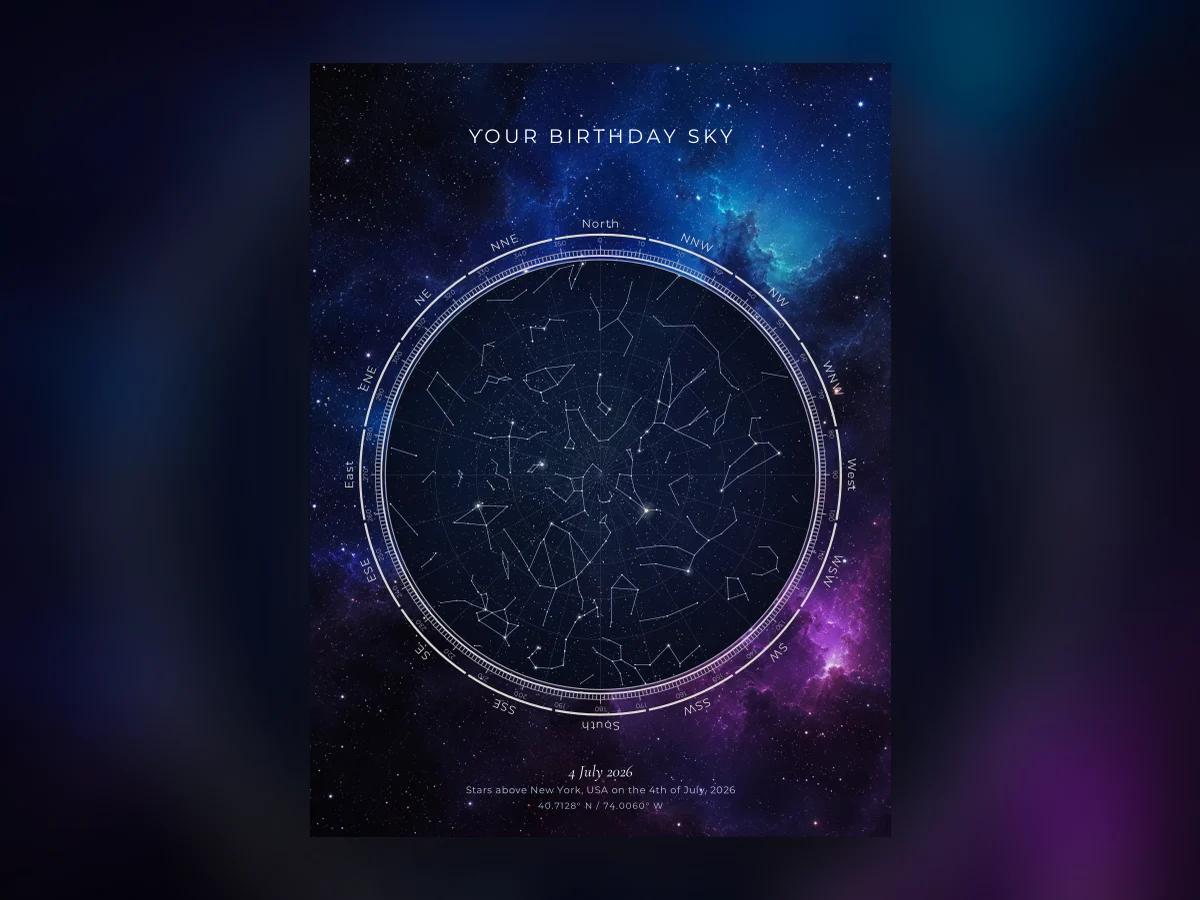
Our designer at [/create](/create) shows your birthday sky as a finished star map, with the date, coordinates and your own words laid out as a print. Enter the date, time and place, choose one of fourteen designs, and the full preview appears in the browser. The preview is free and shows the whole map on screen, with no watermark; nothing is charged unless you decide to buy files or a framed print. It is the right tool if you want to see how the sky looks as an object on a wall.
Both tools will agree on the stars. If you check one against the other, that is a reasonable way to satisfy yourself that a star map is real astronomy and not decoration; the accuracy page describes the catalog and method in detail.
Turning the sky into a print
A birthday star map tends to work best when the words are short and specific. A first name and the date. "The night you arrived." The name of the hospital town in small type beneath the coordinates. Long captions compete with the stars.
On design: the dark backgrounds (navy, noir, galaxy) read as a night sky and suit most rooms; the paper design suits nurseries and lighter interiors. Heart-shaped skies are popular for a child's birth date. A circle or full disc is the more traditional astronomical presentation.
On format: the digital files are $25 and include a PNG and a print-ready PDF at 300 DPI in 12x16, 18x24 and 24x36, delivered by email in minutes. Any local print shop can print them; ask for matte or satin paper, since gloss reflects the room lights back off a dark map. Framed prints are $69, $109 and $179 by size, in a black wood frame with an acrylic front, with free shipping to the US and 40+ countries in 7 to 12 business days and a 14-day money-back guarantee.
If the map is a gift for someone else's birthday, the birthday star map page covers the common choices, including what to write and which moment to pick when the birth hour is unknown, in designs from galaxy to eclipse. For a birth announcement or nursery, the same map works and many people order it the week the baby arrives — see gifts for new parents or the nursery wall art guide.
A short summary
- The stars on your birthday were set by three things: the date (season), the hour (how far the sky had turned) and your latitude (which stars can rise at all).
- A birthday sky contains that season's constellations, the circumpolar stars, and the Milky Way if the season and hour placed it high enough.
- It does not, on most star maps, contain the Moon or planets; check with the maker before assuming.
- The same date and hour each year shows nearly the same stars, because the calendar tracks Earth's orbit. The Moon's phase on your birthday changes every year.
- You can see it free in Stellarium Web or as a print preview at /create, and turn it into files or a framed print if you want it on the wall.
Frequently asked questions
Do I need my exact birth time to see my birthday sky?
No. The stars shift across the sky by about 15 degrees per hour, so a few hours' difference changes which constellations are high and which are near the horizon, but the same season's stars are there either way. If you know the hour from a birth certificate, use it. If not, choosing an evening hour like 10 p.m. gives a sky you could have looked up and seen.
I was born during the day. Is there still a birthday sky?
Yes. The stars are above you in daylight; the Sun simply outshines them. A star map for a daytime birth shows the stars that stood over you at that minute, which is a slightly different and arguably more private pattern, since nobody on the ground saw it that day.
Are the stars on my birthday the same every year?
Very nearly. The calendar year and the stars' return to the same evening position differ by only about twenty minutes, so on the same date and hour each year you see almost the same stars. Over a lifetime, precession shifts the pattern by roughly one degree, about two Moon widths. The Moon and planets are a different matter; they are in different places every year.
Does a birthday star map show the Moon and planets?
Usually not, and you should check with any maker before assuming. Most star maps, including ours, plot fixed stars and constellations only. The Moon and planets move against the stars from night to night, and drawing them at realistic size would cover stars behind them. Some of our designs include a decorative moon graphic; it is not the Moon's actual position or phase.
What is a star map's accuracy, in plain terms?
Ours plots about 9,000 stars from the HYG catalog down to magnitude 6.5, which is roughly the naked-eye limit under a dark sky, and all 88 IAU constellations. Positions are computed for the date, time and location you give to the minute, for dates between 1900 and 2100. The accuracy page explains the method and its limits.
How do I turn my birthday sky into a print?
Design it free in the browser, check the preview, then either buy the 300 DPI files ($25, PNG and PDF in 12x16, 18x24 and 24x36) and print locally, or order a framed print ($69 to $179, free shipping to the US and 40+ countries, 7 to 12 business days). Matte paper suits the dark designs best.