
 by
The Day We Met Star Map: The Sky Above You, Even in Daylight
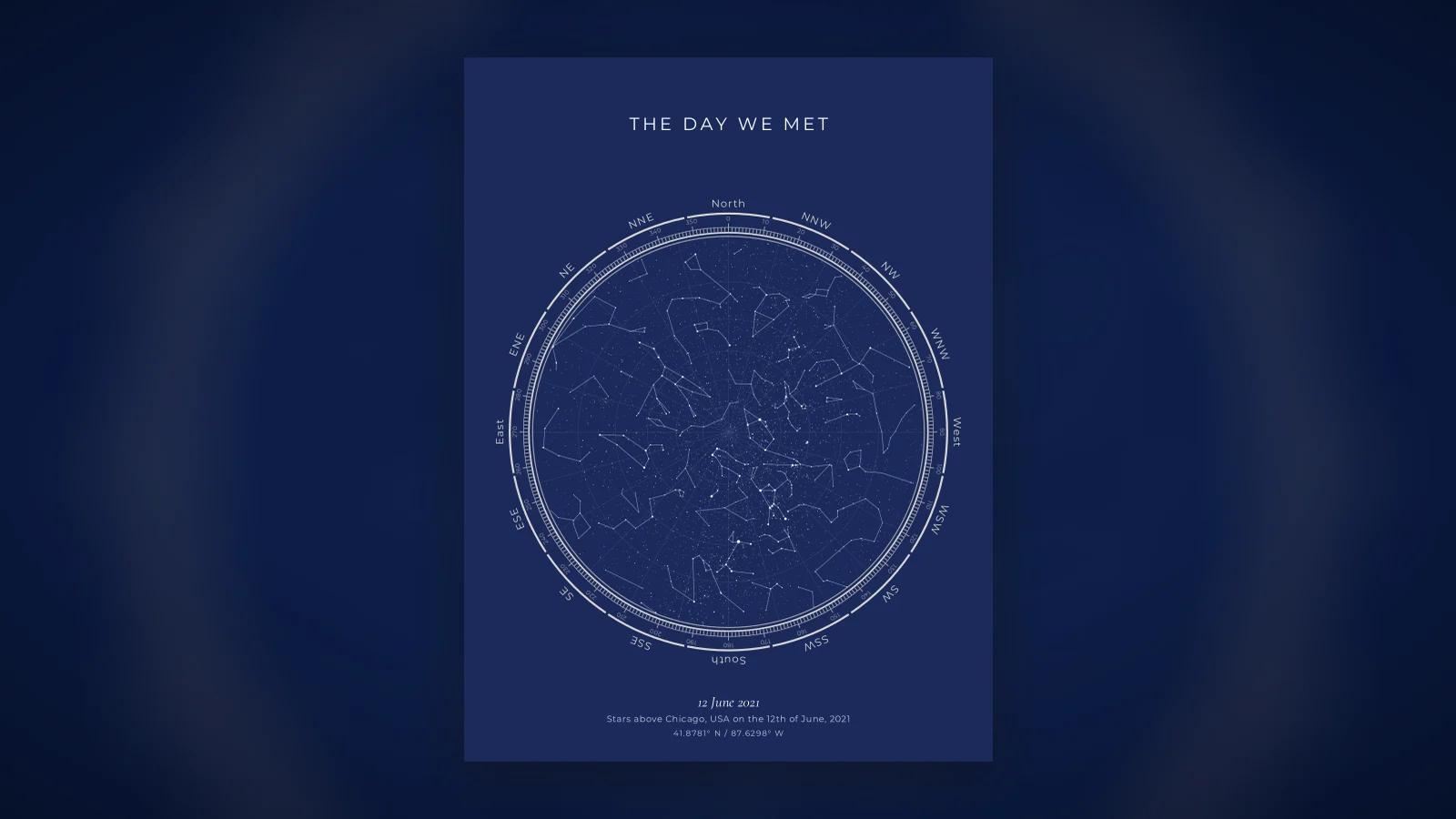
Yes, you can have a star map of the day you met, even if you met at noon in full sunshine. The stars were overhead the whole time; the sun was simply brighter than they were. The day we met star map shows the sky exactly as it stood above you at that hour, with the daylight taken away.
That matters more than it sounds, because a lot of couples did not meet at night. They met at a lunch, in a lecture, at a friend's wedding, on a Saturday morning in a dog park. This guide covers what a daytime map actually shows, how to pin down the hour and the place, and how to word it so it tells the true story rather than borrowing someone else's.
Yes, the stars were there in daylight
The sky does not empty at sunrise. The stars stay exactly where they are; the Earth keeps turning beneath them, and the only thing that changes in the morning is that sunlight scattered by the atmosphere drowns them out. On a clear afternoon there are as many stars above the horizon as there are at midnight. You just cannot see one of them.
There is a pleasing consequence to this. At midday, the constellations above you are roughly the ones that will be overhead at midnight about six months later, because the Sun sits on the opposite side of the sky from the midnight stars. In mid-June the Sun stands in front of Taurus, right beside Orion, so the most famous winter constellation spends summer afternoons above the horizon and out of sight. A couple who met on a June afternoon therefore met under the winter sky, which is a detail nobody at the time could have known.
What a star map of the day you met actually shows
A star map is a calculation, not a photograph. We take the date, the time and the coordinates of the place, work out where about 9,000 stars and all 88 constellations stood relative to that spot at that minute, and draw the dome of the sky as if you were lying on your back looking straight up.
For a daytime moment, the calculation is exactly as accurate as for a night-time one. The map is then drawn on a dark background so the stars are visible, which means the finished print shows the sky that was hidden behind the daylight. What it does not draw is the Sun itself, the Moon or the planets: our maps plot the fixed stars, the constellations and the Milky Way, and leave out the bodies that wander against them. The accuracy page explains the catalog and the method in more detail.
If that sounds like a cheat, think of it the other way round. A photograph of that afternoon would show blue sky and nothing else. The map shows what was really up there.
Finding the hour you met
The place decides which stars are up; the hour decides where they sit. For a night-time meeting, most people remember roughly when it was. Daytime meetings are often hazier, because nobody was watching the clock at a picnic.
Start with anything time-stamped
The first message you exchanged is usually the best clue, and messaging apps keep a time on every one. Photos are the next best: phones store the time a picture was taken, and a photo from the event, even a blurry group shot, often settles it to within a few minutes. Ticket confirmations, calendar invitations, a card payment for the coffee you both ordered, or a post one of you made that day all carry a time as well.
Ask the people who were there
If you met through friends, at a party or a wedding, someone else may remember the timeline better than either of you, or have the photos. A wedding has a printed order of the day, which turns "during the reception" into a time to the half hour.
If all you have is "the afternoon"
Pick the middle of the window you are sure of. The sky turns about 15 degrees an hour, so a guess that is out by an hour or two still gives you most of the same constellations in roughly the same places, and nobody looking at the print will know the difference. What you should not do is invent a precise-looking time like 2:47 pm when you have no idea; if you put a time on the poster, make it one you can stand behind.
The day we met star map, step by step
1. The place
Use the place you actually met, not the city you live in now. A city is enough if the venue is gone or you never knew the address, because the sky above a whole city is effectively the same. If you met on campus, at a park or in a particular building, you can enter the exact coordinates for a little more precision; the designer has an option for this.
2. The date and the time
Enter the date and the hour you settled on. The time is read in the local time of the place you chose, and the time zone and daylight saving are worked out automatically, so 2:30 pm in Chicago in June is treated as 2:30 pm Chicago summer time without you converting anything. If you met somewhere you were only visiting, use the local time there, not the time back home.
3. The words
A title, a short line beneath it, and optionally the place, date and coordinates printed small at the bottom. More on wording below; the short version is to describe what happened.
4. The design
Choose the look last, once the sky and the words are right, because a design that suits a long title may not suit a short one. The designer is free to use and shows the finished map, with your sky and your words, before you pay anything.
Which design suits a daytime meeting
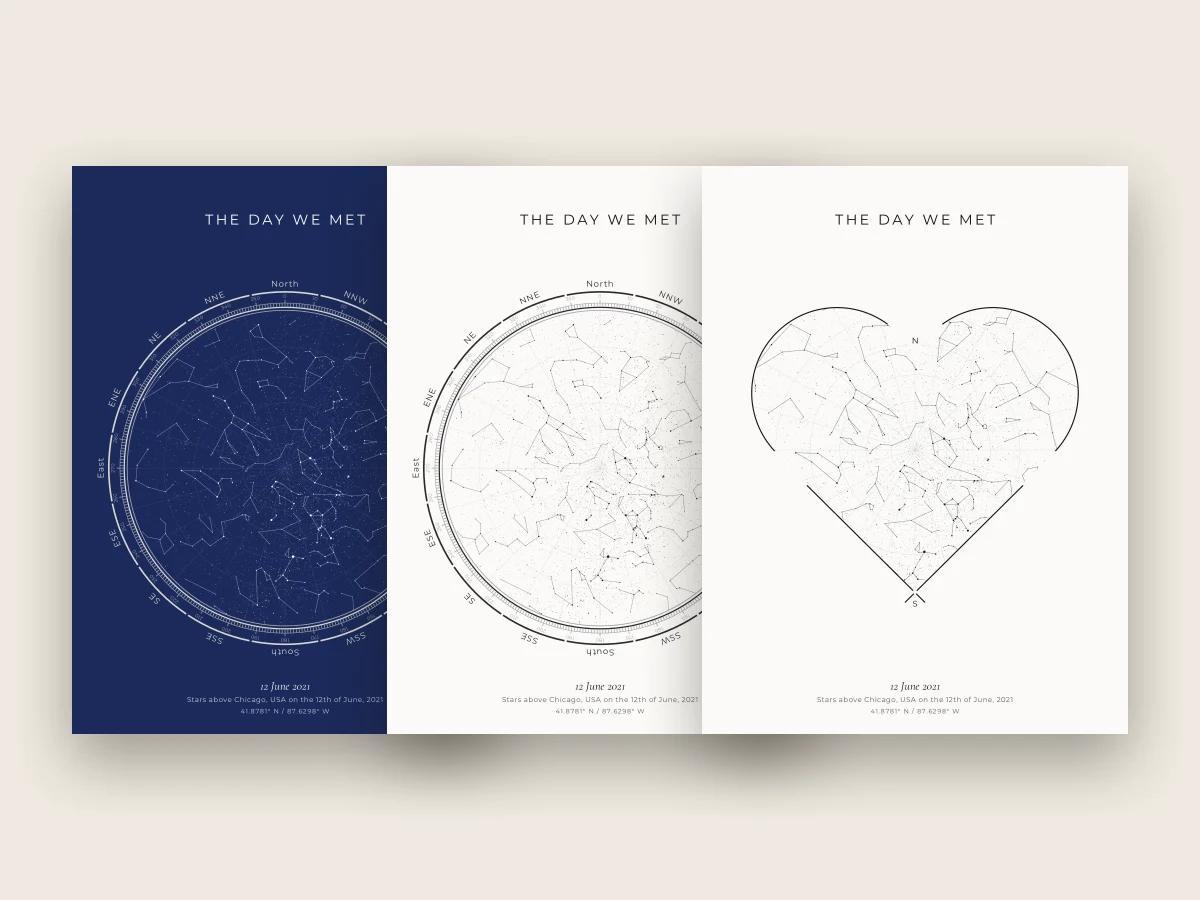
Every design shows the same sky; the choice is about the room it hangs in and the story it tells. Dark designs read as night, which is part of why they are popular for "the night we met". For a meeting that happened in daylight, a light design can be the more honest picture of the day.
Light designs
Paper prints the sky in dark ink on an off-white poster, like a page from an old atlas, and is the closest thing to a daytime look. Heart White does the same inside a heart, and suits a couple who want the romance stated plainly. Both sit well in bright rooms and against pale walls.
Dark designs
Navy is the classic: a deep blue disc with a fine compass ring, the design most people picture when they think of a star map. It works for a daytime meeting too, as a picture of what was overhead rather than of how the sky looked; the title tells the rest.
If you are unsure, put the same sky in two designs side by side in the designer and look at them for a minute each. One usually starts to feel like yours.
Wording for a day, not a night
"The night we met" is a lovely phrase, and it is used so often that it has become a default. If you met at lunch, the most personal thing you can do is not use it.
Titles that describe what happened
- The day we met / 12 June 2021, Chicago
- Saturday, 2:30 pm / the moment everything changed
- First coffee / and every one since
- Under a sky we could not see / the day it all began
- Row F, seat 12 / where I sat down next to you
A title with a detail only the two of you know, the seat number, the coffee order, the name of the friend who introduced you, tends to mean more over the years than a general romantic line.
The small print
Most designs can print the place, the date and the coordinates beneath the title. For a daytime meeting, adding the time is worth considering, because "2:30 pm" quietly explains why the title says day and not night. Our wording guide has more lines and a few rules for keeping them short.

When the day you met and your first date are different days
For many couples, meeting and the first real date are weeks apart: you met at a friend's barbecue in the afternoon, and the first dinner alone came a month later. Both are fair answers to "when did it start", and you do not have to choose.
One option is a pair of maps in the same design and size, hung side by side: the afternoon you met on the left, the evening of the first date on the right, each with its own short title. Seen together, they show two different skies, one from daylight and one from the dark, which tells the story of how it went better than either map alone. If you would rather have one piece, pick the moment you both bring up first when someone asks how you met.
Pairing it with something from the day itself
A map is a record of where and when. It works best alongside one small thing that records what. A few ideas that cost little or nothing:
- Go back at the same hour. Return to the same café, park or campus at the same time of day, on the date or the nearest weekend to it.
- Write it down separately. Each of you writes how you remember the day, without comparing first. The details that do not match are usually the best part.
- Keep the evidence. The receipt, the ticket, the name badge from the conference, stored in a box or behind the frame.
If the day turned into an evening and the evening is the part you both remember, the night we met keepsake guide covers that version of the story in more detail.
Who it suits, and who it does not
It suits a couple who know where they met and roughly when, and who like the idea that the sky they could not see that day is the one on their wall. It suits a first anniversary of meeting particularly well, while the details are still easy to find.
It is the wrong gift if neither of you can remember the place, because the place is half of what the map is made from, and an invented one undercuts the whole idea. It is also the wrong format if what you really want is a picture of the day itself, the light, the people, the weather: a framed photograph from that afternoon will say that better than any chart.
The digital files are $25 and arrive by email in minutes: a 300 DPI PNG and a print-ready PDF in 12x16, 18x24 and 24x36, which you can print at home or at a local shop. Framed prints are $69, $109 and $179 by size, in a black wood frame with an acrylic front, with free shipping to the US and 40+ countries and delivery in 7 to 12 business days. Every order has a 14-day money-back guarantee, and the full options are on the pricing page and the night we met star map page, which covers daytime meetings too.
If you have the place and a rough hour, the designer will show you the sky that was above the two of you that day, before you decide anything.
Frequently asked questions
Can you make a star map for a meeting that happened during the day?
Yes. The stars are above the horizon at every hour, day or night; in daylight the sun simply outshines them. A star map is calculated from the date, time and place, so it shows exactly which stars and constellations stood over you at 2 pm just as accurately as at midnight. The map draws them on a dark sky so you can see what daylight was hiding.
Does a daytime star map show the sun?
Ours does not. Our maps plot the stars, the 88 constellations and the Milky Way for your moment, but not the Sun, the Moon or the planets, which move against the stars over days and weeks. So a map of a sunny afternoon looks like a clear night sky. If seeing the Sun's position matters to you, a star map is the wrong format and an astronomy app is the better tool.
What time should I use if we only remember "the afternoon"?
Pick the middle of the window you are sure of, so 3 pm for "sometime in the afternoon". The sky turns about 15 degrees an hour, so a guess within an hour or two still gives you most of the same constellations in roughly the same places. If you can narrow it with a message timestamp or a photo, use that instead and the map will be right to the minute.
Should the title say "the day we met" or "the night we met"?
Say what actually happened. If you met at a lunch, a lecture or a wedding in the afternoon, "the day we met" is truer and reads as more personal, because it tells anyone looking at it that the detail is real. "The night we met" is a common phrase, which is exactly why a daytime couple can make their map stand out by not using it.
Is a day we met star map a good first anniversary gift?
It suits the first anniversary of meeting well, because the date is fresh enough to pin down and the gift is specific to the two of you. For a very new relationship, the digital files at $25 are a proportionate choice; a framed print reads as a bigger statement. It is a weaker choice if neither of you can remember where you met, since the place is half of what the map is made from.