
 by
by Constellations Explained: Why There Are Exactly 88
Ask how many constellations there are and you will get a definite answer, 88, which is unusual for a question about the sky. Most things up there come with caveats. The number of constellations does not, because it was settled by committee a century ago, after two thousand years of astronomers, sailors and mapmakers adding figures wherever they found space.
This article explains how the count reached 88 and why it stopped there, what a constellation actually is (and what the Big Dipper is instead), how the astrological zodiac diverged from the astronomical one, why the boundaries matter for a star map, and which constellations you can expect to see from where you live.
What a constellation is now
Start with the modern definition, because it is different from the everyday one. To an astronomer today, a constellation is not a pattern of stars. It is a region of the sky, with fixed borders, like a country on a map. The pattern, the hunter or the swan or the scales, is the historical figure that gave the region its name. Every star, galaxy, nebula and point of empty space lies inside exactly one of the 88 regions, whether or not it belongs to the figure.
That is why an astronomer can say a comet is "in Leo" when it is nowhere near the lion's stars, and why the count is exactly 88 rather than "about 88": the sky has been partitioned, and the partition is complete.
How the count grew
Ptolemy's 48
The oldest layer comes from Mesopotamia and Greece. Babylonian astronomers were tracking star figures more than three thousand years ago, and the Greeks inherited many of them. Around AD 150 the astronomer Claudius Ptolemy, working in Alexandria, set down 48 constellations in his Almagest, together with a catalog of about a thousand stars assigned to them. Ptolemy did not invent the figures; he recorded the tradition. But his list became the standard for the next fourteen centuries.
The 48 include almost everything a northern observer would recognise: Ursa Major and Minor, Orion, Taurus, Leo, Scorpius, Cygnus, Cassiopeia, the twelve of the zodiac, and so on. They also include one that no longer exists, the enormous ship Argo Navis.
Ptolemy's sky had a hole in it. From Alexandria, at 31 degrees north, the region around the south celestial pole never rises, so nobody in the Greek tradition had named it.
The southern additions
That hole was filled by navigators. In 1595 to 1597 two Dutch seamen, Pieter Dirkszoon Keyser and Frederick de Houtman, charted the far southern stars on a voyage to the East Indies. Their observations gave rise to twelve new constellations, which appeared on a globe by Petrus Plancius in 1598 and in Johann Bayer's atlas Uranometria of 1603: among them the Peacock (Pavo), the Toucan (Tucana), the Southern Triangle and the Flying Fish. Plancius also filled gaps in the northern sky with Camelopardalis, the Giraffe, and Monoceros, the Unicorn.
In 1687 the Polish astronomer Johannes Hevelius added seven more in the faint spaces between Ptolemy's figures, including Lynx, named, he said, because you needed the eyes of one to see it, and Canes Venatici, the hunting dogs.
The largest single contribution came from the French astronomer Nicolas-Louis de Lacaille, who spent 1751 and 1752 at the Cape of Good Hope cataloguing nearly ten thousand southern stars. He introduced fourteen constellations, nearly all named for instruments of science and art: the Microscope, the Telescope, the Pendulum Clock, the Chemical Furnace, the Air Pump. He also did something more drastic. Ptolemy's ship Argo Navis was so large that it was awkward to use, and Lacaille broke it into three: Carina (the keel), Puppis (the stern) and Vela (the sails). That is why the count reaches 88 with 47 of Ptolemy's originals rather than 48.
The ones that did not survive
By the nineteenth century the sky was crowded. Atlases carried figures that other atlases ignored: a cat (Felis), a solitary thrush, a hot-air balloon, a printing press, an electrical machine, and several monarchs' emblems. One casualty, the Mural Quadrant, survives only in the name of the Quadrantid meteor shower each January. There was no authority to say which figures counted, so the number of constellations depended on whose map you owned.
The IAU settles it: 1922 and 1930
The International Astronomical Union was founded in 1919, and at its first General Assembly in Rome in 1922 it adopted an official list of 88 constellations, along with the three-letter abbreviations (Ori, UMa, Sco) still in use. The American astronomer Henry Norris Russell drew up the list. It kept the well-established figures, dropped the obscure ones, and confirmed Lacaille's division of the ship.
A list is not a map. The IAU then asked the Belgian astronomer Eugène Delporte of the Royal Observatory at Uccle to draw boundaries between the 88. He ran them along lines of right ascension and declination, the sky's equivalent of longitude and latitude, as they stood in 1875, so that the borders would be straight on charts of that era. The result was adopted in 1928 and published in 1930, and it has not changed since. The IAU's constellation pages carry the full list and the official boundary charts.
A few details of that partition are worth knowing. One constellation, Serpens, is in two separate pieces, the head and the tail, on either side of Ophiuchus, who holds it. The largest constellation is Hydra, the water snake, stretching more than a quarter of the way round the sky; the smallest is Crux, the Southern Cross, which would fit inside Hydra about nineteen times. Because the boundaries were fixed to the sky of 1875, precession has since tilted them very slightly against the modern grid, which is invisible to the eye and tidy enough for every practical purpose.
Constellations versus asterisms
Here is where the everyday meaning and the official one part company.
The Big Dipper is not a constellation. It is seven bright stars that form the hindquarters and tail of Ursa Major, the Great Bear, which is one of the largest constellations in the sky and includes a great many stars the Dipper leaves out. A pattern of stars like this, familiar and useful but not one of the 88, is called an asterism.
Asterisms are everywhere once you look. The Summer Triangle joins the brightest stars of three different constellations, Lyra, Cygnus and Aquila. The Great Square of Pegasus borrows one corner from Andromeda. Orion's Belt is three stars inside Orion. The Sickle is the head of Leo; the Teapot is the heart of Sagittarius; the Keystone is the middle of Hercules. None of them is official, all of them are helpful, and a good star map's constellation lines often pick them out because they are what the eye actually finds.
This is also the answer to a question about the lines on a star map. The line figures drawn between stars are not part of the IAU definition. The IAU fixed the regions and the names, not the connect-the-dots. Different atlases join the stars differently, and all are equally correct.
The zodiac: astronomy and astrology
The zodiac is the band of constellations the Sun passes through in its yearly circuit around the sky. In the IAU's partition, the Sun's path crosses thirteen constellations, not twelve: the familiar ones plus Ophiuchus, the serpent-bearer, whose southern edge dips across the Sun's track between Scorpius and Sagittarius. They are also wildly unequal. The Sun spends about six weeks crossing Virgo and barely a week in Scorpius.
The astrological signs are something else. They are twelve equal slices of 30 degrees each, laid along the Sun's path more than two thousand years ago, and named for the constellations that then lay behind them. Since then, precession, the slow wobble of Earth's axis, has shifted the whole background of stars by roughly one sign, so the Sun is generally in the constellation before the one its sign is named for. Someone whose sign is Aries was, in the IAU sense, born with the Sun in Pisces.
None of this is a criticism of anyone's horoscope, which was never meant as a statement about the constellations' boundaries. It is only to say that when a star map says "the sky on your birthday", it means the 88, not the twelve.
Why the boundaries matter for a star map
A custom star map plots every naked-eye star for a moment and draws the constellation figures through them. The IAU boundaries do two quiet jobs in that picture.
First, they decide which name goes where. Every star on the map belongs to exactly one constellation, so labelling is unambiguous, and the label for a figure that is half below the horizon can be placed correctly on the half that shows.
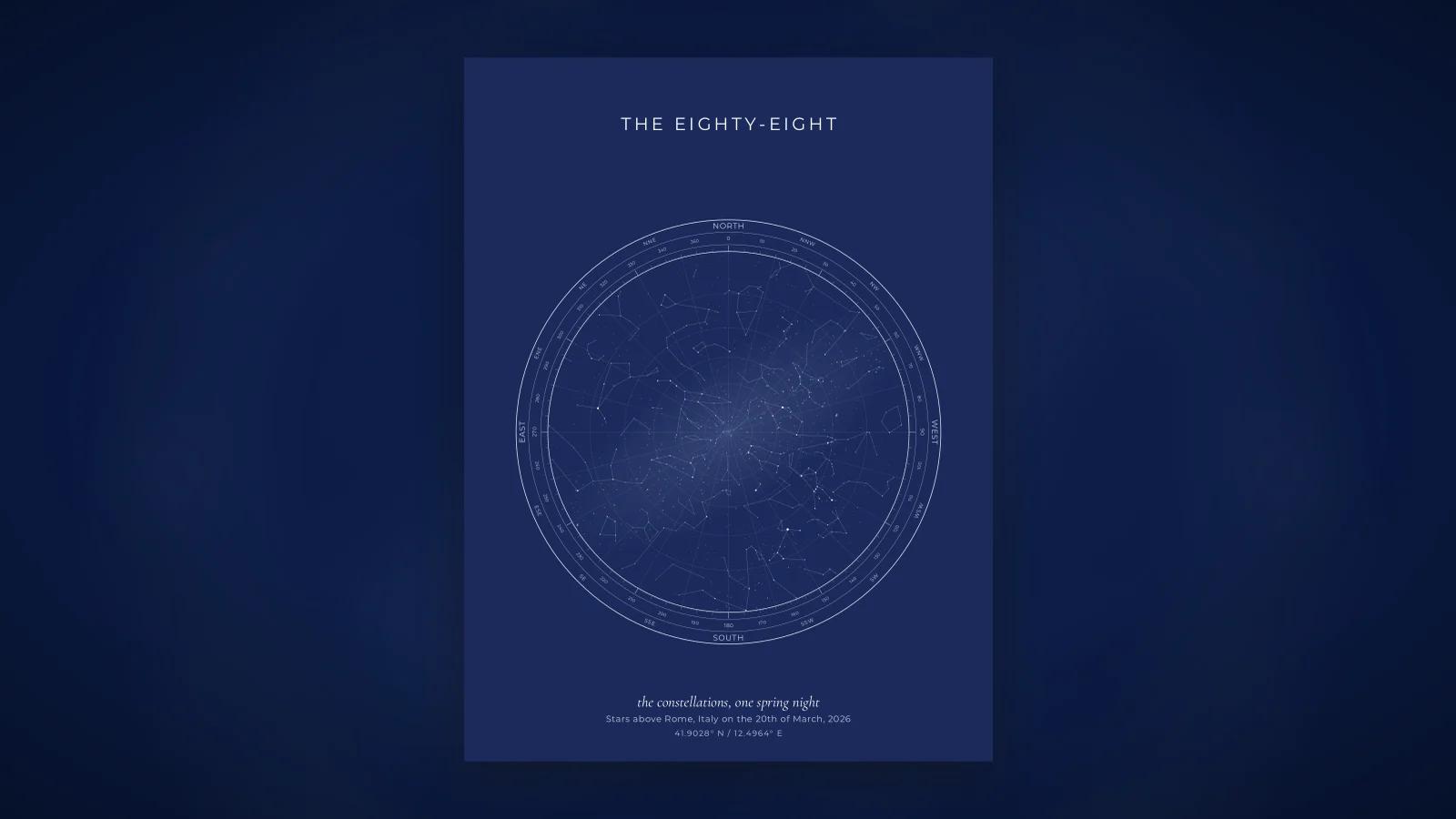
Second, they define completeness. A map that claims all 88 constellations is making a checkable statement: the full partition of the sky is in the data, and whichever regions are above the horizon at your moment are the ones drawn. A map with "the major constellations" is making a vaguer one. Ours carries all 88 as line figures, with names on a toggle; the accuracy page sets out the catalog and the method behind them.
Which constellations are visible when
Two things determine what you can see: where you are, and the time of year.
Latitude sets the hard limit. From any spot on Earth, the sky within your latitude's distance of the opposite pole never rises. From 40 degrees north, anything within 40 degrees of the south celestial pole is permanently hidden: Octans, Apus, Chamaeleon, Musca, Crux, Triangulum Australe and their neighbours. Roughly 60 of the 88 rise fully at some point in the year from that latitude, another dozen or so show partly, and the rest never appear. From 40 degrees south the situation mirrors: Ursa Minor, Cepheus and Camelopardalis are never seen, and the southern group is on view all year.
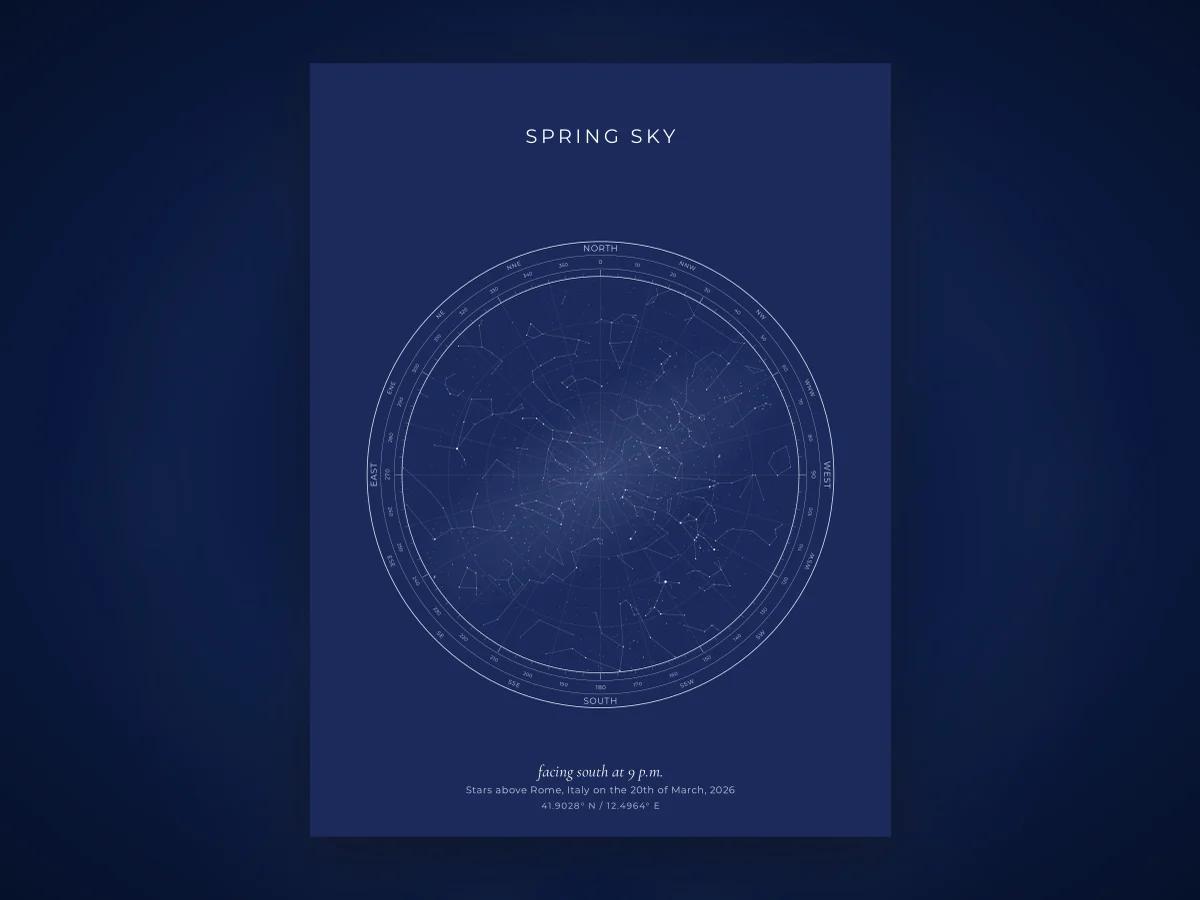
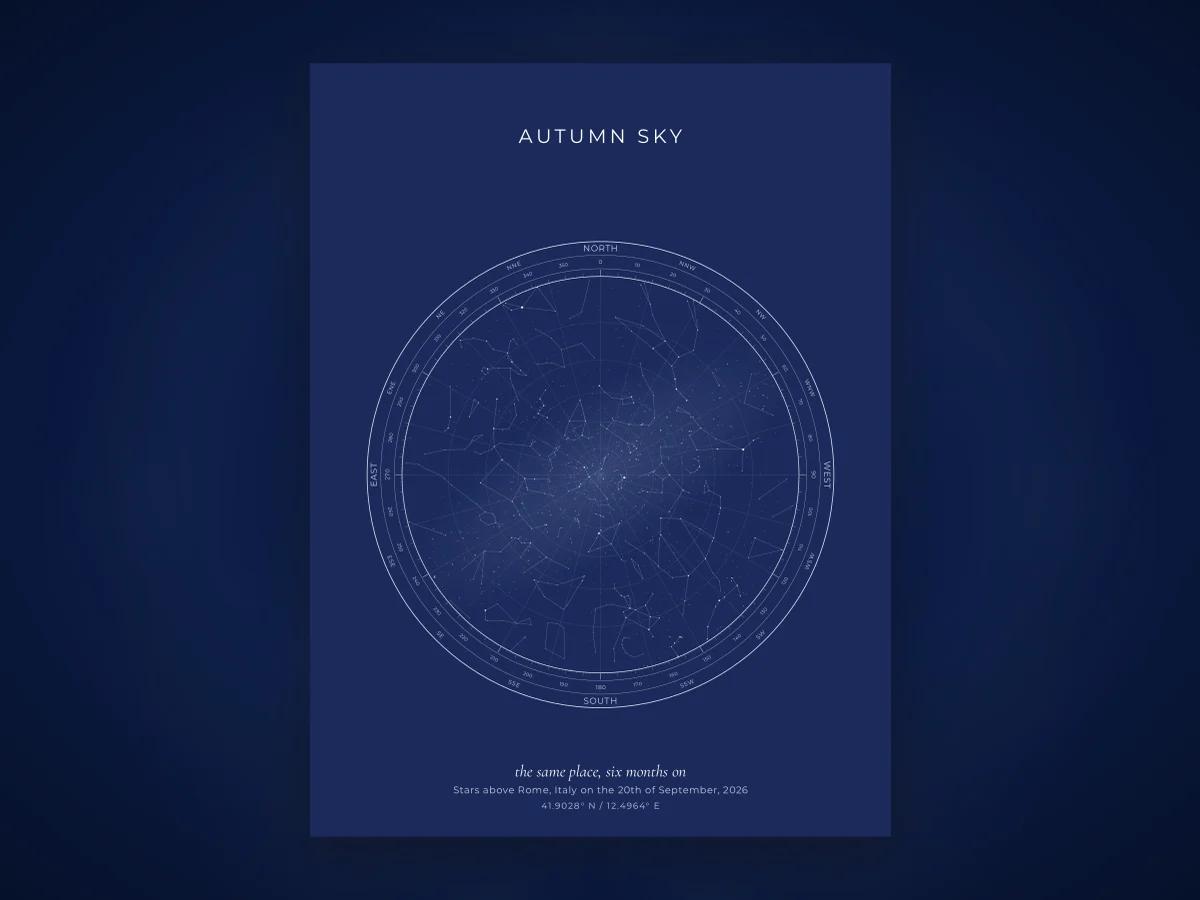
The time of year sets which of the visible ones are up at night. On northern winter evenings the sky belongs to Orion, Taurus, Gemini, Auriga and Canis Major; spring brings Leo, Virgo and Boötes; summer, Lyra, Cygnus, Aquila, Scorpius and Sagittarius; autumn, Pegasus, Andromeda and Cassiopeia. The article on why the stars change with the seasons explains the mechanism. Near the pole, the circumpolar constellations, Ursa Minor, Ursa Major, Cassiopeia, Cepheus and Draco from mid-northern latitudes, are up every night of the year.
So a map of any single moment shows somewhere between a third and a half of the 88, which is the part of the partition that was over your head. If you want to see which ones stood over a date that matters to you, the designer draws them free in the browser in a navy or any other design, and the sky over your birthday is the usual place people start.
Frequently asked questions
How many constellations are there?
Eighty-eight, by international agreement. The International Astronomical Union adopted the list in 1922 and fixed the boundaries between them in 1930, so that every point in the sky belongs to exactly one constellation. Before that, the number depended on which atlas you owned.
Is the Big Dipper a constellation?
No. The Big Dipper, called the Plough in Britain, is an asterism, an informal pattern of stars. Its seven stars belong to the constellation Ursa Major, the Great Bear, which is much larger and includes many fainter stars around them. The Summer Triangle, the Great Square of Pegasus and Orion's Belt are asterisms too.
Why are there 13 constellations in the zodiac but 12 signs?
The Sun's path crosses 13 IAU constellations, including Ophiuchus, and they are very unequal in size. The astrological signs are twelve equal 30-degree divisions of that path, fixed over two thousand years ago. Precession has since shifted the constellations about one sign along, so the sign and the constellation the Sun is actually in no longer match.
Who decided the constellation boundaries?
The Belgian astronomer Eugene Delporte, working for the International Astronomical Union. He drew the boundaries along lines of right ascension and declination for the sky as it stood in 1875, and the IAU published them in 1930. They have not changed since.
Can I see all 88 constellations from where I live?
Only from near the equator, and even then not all at once. From the mid-northern latitudes, roughly 60 rise fully at some time of year, another dozen or so show partly, and a group around the south celestial pole never rises at all. The reverse holds in the south, where Ursa Minor and its neighbours are never seen.