
 by
by The Brightest Stars You Can See From Your Backyard
Ask most people to name a bright star and they say the North Star. It is a good answer to a different question. Polaris is famous for standing still, not for shining; on the list of the sky's brightest stars it does not make the top forty.
The stars that actually dominate a clear night are a smaller and less familiar group, and knowing them changes how the sky looks. Once you can pick out Arcturus or Capella by name, the whole season falls into place around it. Here are the seventeen brightest as seen from Earth, in order, with where to find each, when to look from the northern mid-latitudes, and one thing worth remembering about it.
A note on the numbers first. Brightness is measured in magnitudes, and the scale runs backwards: lower is brighter, and the very brightest stars have negative values. The figures below are approximate, because several of these stars vary and different catalogs round differently. The ranking, though, is stable enough to learn.
1. Sirius
Constellation: Canis Major. Best seen: winter evenings, low in the south below Orion. Magnitude: about minus 1.5.
The brightest star in the night sky by a wide margin, and one of the closest, at about 8.6 light-years. Its brilliance is mostly a matter of proximity: Sirius is only about twenty-five times as luminous as the Sun, modest by the standards of this list. It has a faint white-dwarf companion, Sirius B, first seen in 1862, the collapsed remnant of a star that was once the larger of the pair. Near the horizon Sirius twinkles violently in changing colours, which generates a steady trickle of reports of something strange in the sky.
2. Canopus
Constellation: Carina. Best seen: southern hemisphere; from the southern United States, low in the south on February evenings. Magnitude: about minus 0.7.
The second-brightest star and a genuine giant, around ten thousand times the Sun's luminosity at roughly 310 light-years. It never rises from Europe or most of North America; from roughly 37 degrees north and southward it skims the horizon beneath Sirius. Spacecraft have used Canopus as a navigation reference for decades, because it is bright, isolated, and far from the plane of the solar system.
An aside for completeness: between Canopus and Arcturus sits Alpha Centauri, the nearest star system to the Sun, whose two main stars combine to about magnitude minus 0.3. It is too far south to be seen from the mid-northern latitudes and so is left off this list, but from Australia or South Africa it is one of the two pointers to the Southern Cross.
3. Arcturus
Constellation: Boötes. Best seen: spring evenings, high in the east and south; follow the arc of the Big Dipper's handle. Magnitude: about minus 0.05.
The brightest star of the northern celestial hemisphere and distinctly orange to the eye, an ageing giant about 37 light-years away. It moves across the sky unusually fast for a bright star, having come from a different orbit around the galaxy than the Sun's, and in a few thousand years its position will have visibly shifted. Its light was used to switch on the floodlights of the 1933 Chicago World's Fair, chosen because the light was then believed to have left the star during the previous fair in 1893.
4. Vega
Constellation: Lyra. Best seen: summer evenings, nearly overhead. Magnitude: about 0.0.
A white star 25 light-years away and, for a long time, the zero point of the magnitude scale: other stars were measured against it. It was the pole star around 12,000 BC and will be again in about 12,000 years, as Earth's axis slowly circles. In 1983 an infrared satellite found Vega surrounded by a disc of cool dust, the first evidence of planet-forming material around another ordinary star.
5. Capella
Constellation: Auriga. Best seen: winter evenings, high overhead; nearly circumpolar from northern Europe. Magnitude: about 0.1.
Yellowish, like the Sun, and for a reason: the light is dominated by two yellow giant stars orbiting each other closely every 104 days, with a distant pair of red dwarfs making four in all. Capella is the brightest star that lies close to the north celestial pole, which is why from Britain or Scandinavia it can be found low in the north even on summer nights.
6. Rigel
Constellation: Orion. Best seen: winter evenings, Orion's lower right foot. Magnitude: about 0.1.
A blue supergiant roughly 860 light-years away and among the most luminous stars visible without aid, tens of thousands of times the Sun's output. It carries the designation Beta Orionis despite usually outshining Alpha, Betelgeuse, a reminder that Bayer's seventeenth-century letters were not always assigned strictly by brightness.
7. Procyon
Constellation: Canis Minor. Best seen: winter evenings, left of Orion and above Sirius. Magnitude: about 0.4.
Its name means "before the dog", because from mid-northern latitudes it rises shortly before Sirius. It is close, about 11.5 light-years, and like Sirius it has a white-dwarf companion. Procyon, Sirius and Betelgeuse make the large, nearly equilateral Winter Triangle.
8. Achernar
Constellation: Eridanus. Best seen: southern hemisphere; from about 33 degrees north and southward, low in the south on autumn and early winter evenings. Magnitude: about 0.5.
The star at the southern end of the long, winding river of Eridanus. It spins so fast that it is the most flattened star known, its equator bulging noticeably wider than its poles. From Europe and most of North America it never rises.
9. Betelgeuse
Constellation: Orion. Best seen: winter evenings, Orion's upper left shoulder. Magnitude: variable, usually around 0.5.
A red supergiant so large that, placed where the Sun is, it would swallow the inner planets. It swells and shrinks irregularly, and in late 2019 and early 2020 it dimmed to about a third of its usual brightness. ESA and NASA's Hubble observations traced the Great Dimming to a cloud of dust the star had ejected, cooling in front of it. Betelgeuse will end as a supernova at some point in the next hundred thousand years or so; when it does it will be visible in daylight.
10. Altair
Constellation: Aquila. Best seen: summer evenings, the southern corner of the Summer Triangle. Magnitude: about 0.8.
Close, at about 17 light-years, and spinning so quickly that it completes a rotation in around nine hours, which makes it visibly oblate. Two fainter stars flank it in a short line, making Altair easy to confirm once you have found it.
11. Aldebaran
Constellation: Taurus. Best seen: winter evenings, up and right from Orion's belt. Magnitude: about 0.9.
The orange eye of the Bull. It appears to sit among the V-shaped Hyades cluster but is a foreground star at less than half the cluster's distance, about 65 light-years. Being close to the ecliptic, it is occasionally covered by the Moon. Pioneer 10, launched in 1972, is drifting roughly in its direction and will pass it in about two million years.
12. Spica
Constellation: Virgo. Best seen: spring evenings, low in the south-east; "arc to Arcturus, then spike to Spica". Magnitude: about 1.0.
Two hot blue stars orbiting each other every four days, so close that each is pulled into an egg shape by the other's gravity. In the second century BC, Hipparchus compared Spica's position with older records and discovered precession, the slow wobble of Earth's axis.
13. Antares
Constellation: Scorpius. Best seen: summer evenings, low in the south. Magnitude: variable, about 1.0.
The name means "rival of Mars", for its colour, and when Mars passes nearby every couple of years the two are easily confused. Antares is a red supergiant several hundred light-years away, similar in kind to Betelgeuse, and like it the star varies slowly in brightness.
14. Pollux
Constellation: Gemini. Best seen: winter evenings, above and left of Orion, beside Castor. Magnitude: about 1.1.
The brighter of the Twins, though it carries the Beta designation, and the nearest giant star to the Sun at about 34 light-years. A planet at least twice Jupiter's mass was confirmed orbiting it in 2006, one of the first found around a star visible to the naked eye. Pollux is orange; Castor beside it is white, which is the quick way to tell them apart.
15. Fomalhaut
Constellation: Piscis Austrinus. Best seen: autumn evenings, low in the south, in a region with no other bright stars. Magnitude: about 1.2.
The "lonely star of autumn", about 25 light-years away, ringed by a broad belt of dust that the Hubble Space Telescope imaged directly. A point of light within the ring, announced in 2008 as a planet, was later shown to be more likely an expanding cloud of debris from a collision; the ring itself is real and has since been mapped in detail by the James Webb Space Telescope.
16. Deneb
Constellation: Cygnus. Best seen: summer and autumn evenings, the tail of the Swan and the northern corner of the Summer Triangle. Magnitude: about 1.25.
The faintest-looking of the Summer Triangle and by far the most distant: its distance is uncertain but is probably between 1,500 and 2,600 light-years, which makes it one of the most luminous stars the naked eye can see. Vega and Altair are neighbours of the Sun by comparison. Deneb will be a rough pole star in about eight thousand years.
17. Regulus
Constellation: Leo. Best seen: spring evenings, the bottom of the Sickle, the Lion's heart. Magnitude: about 1.4.
Regulus lies within half a degree of the ecliptic, closer than any other first-magnitude star, so the Moon regularly passes in front of it and, very rarely, a planet does too. It spins fast enough to be markedly flattened and to be much hotter at its poles than at its equator.
Where Polaris fits
Polaris shines at about magnitude 2, roughly two and a half times fainter than Regulus at the bottom of this list, and sits somewhere around forty-eighth in the ranking. Its importance is entirely positional. It lies within a degree of the north celestial pole, so it stays put while everything else wheels around it. Find the Big Dipper, extend the two stars at the end of the bowl, and there it is: a modest star doing an important job.
Seeing them on a map
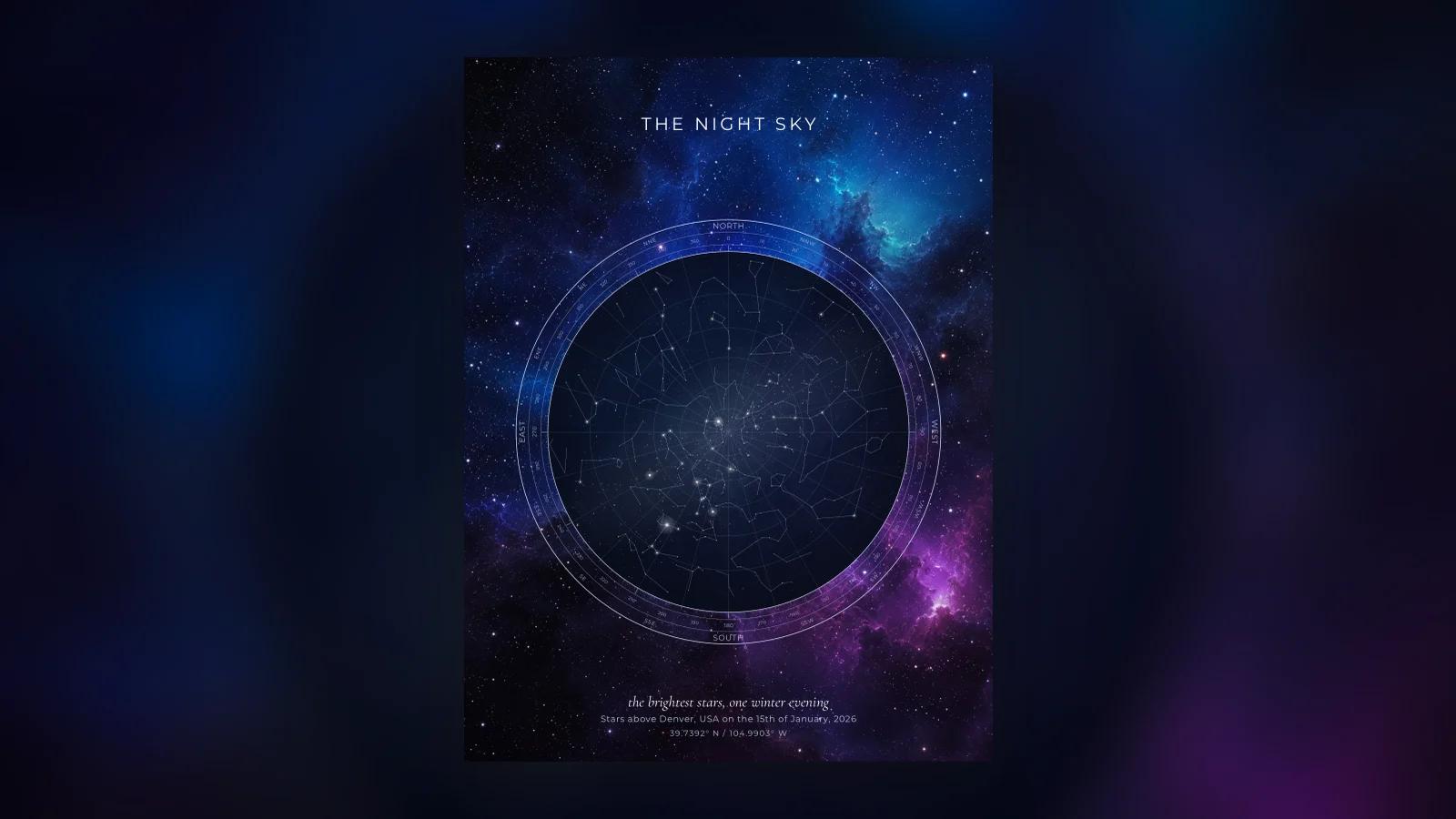
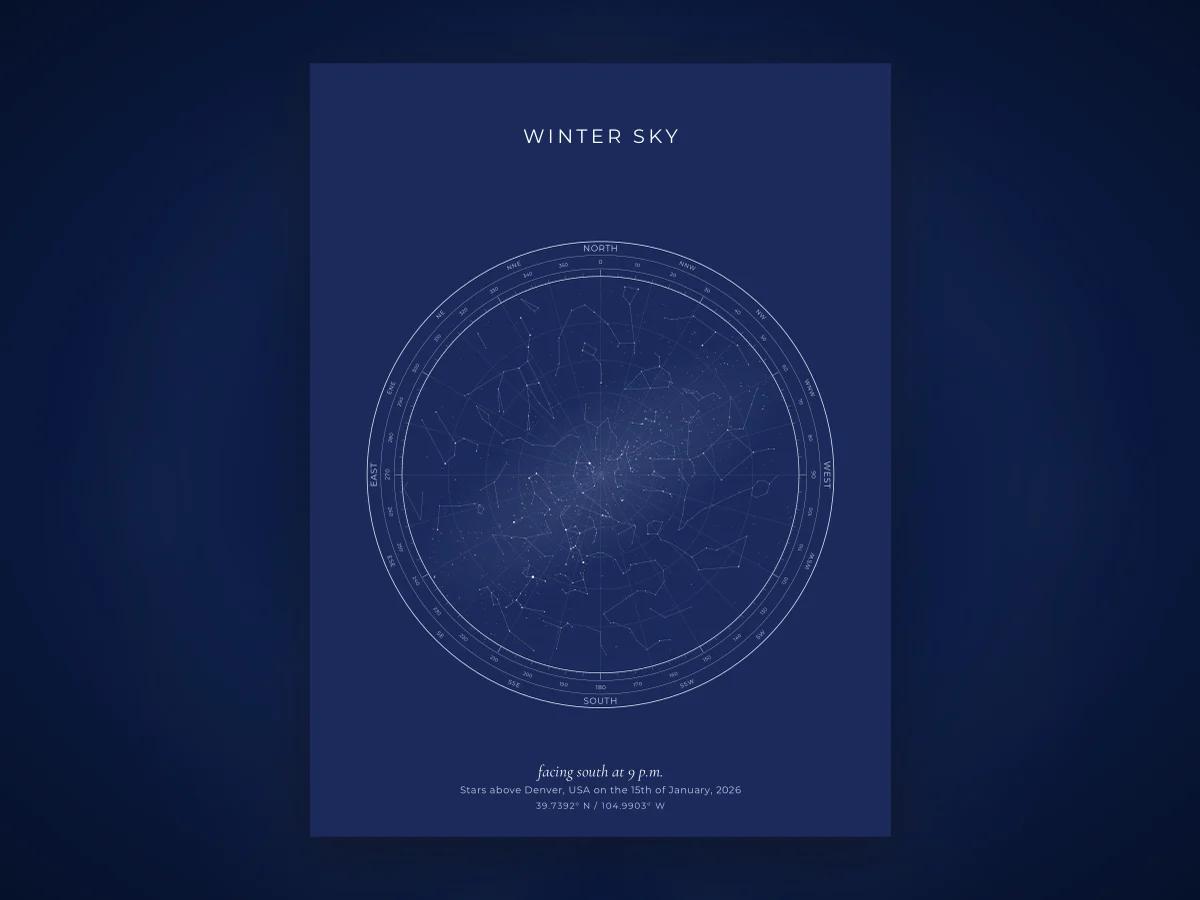
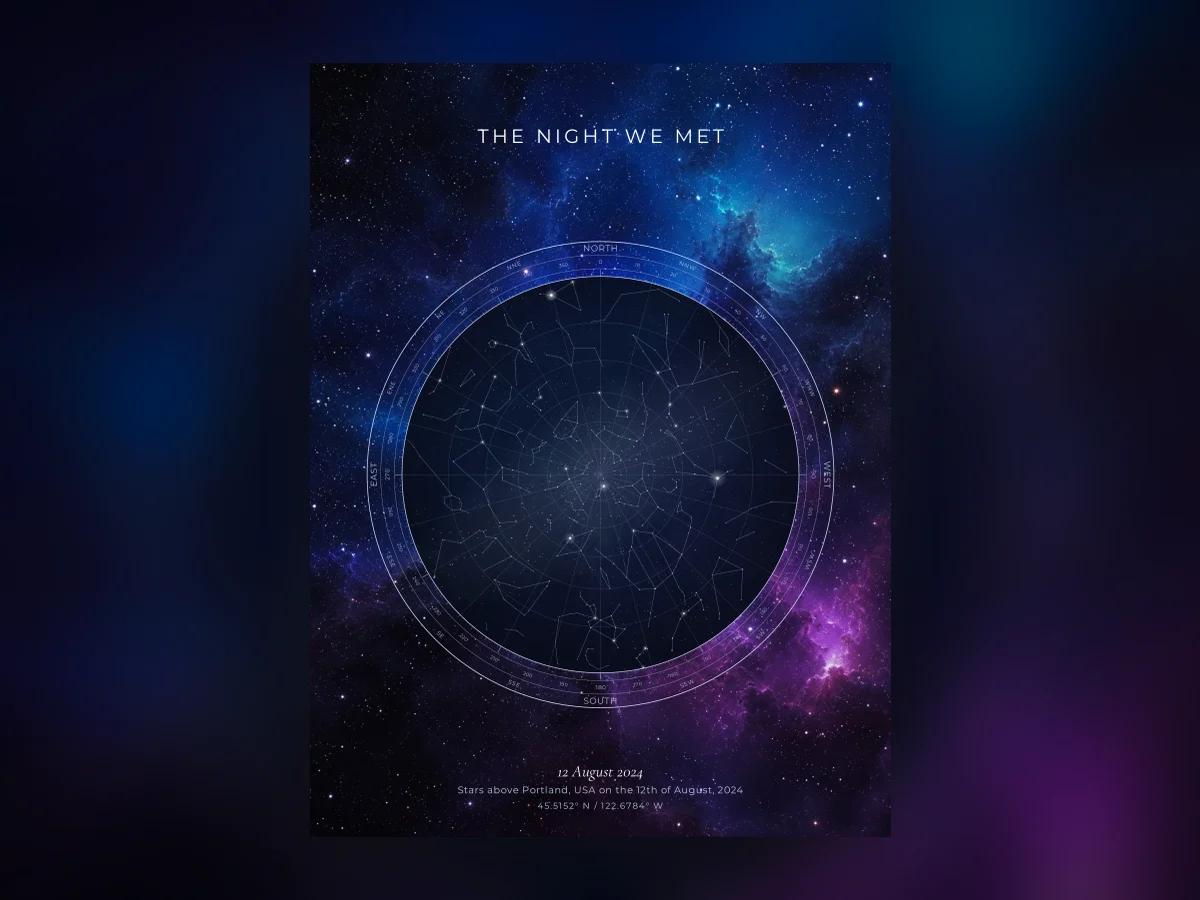
On a star map drawn to scale of brightness, the stars above are the ones that jump out. Our maps size each dot by magnitude and add a soft glow to the very brightest, so Sirius or Vega reads immediately even without labels; the accuracy page explains the catalog and the magnitude limit behind it. Which of these stars stood over a particular night, and where, depends on the date, the hour and the place, which is the whole point of drawing a map of a specific moment. If you would like to see which were above you on a date you care about, the designer draws it free in the browser, and the guide to reading a star map explains how to find them on the result. Winter births, for what it is worth, get the richest share of this list, which makes a new baby star map or an anniversary map in the navy design a natural way to keep one particular winter sky.
Frequently asked questions
What is the brightest star in the night sky?
Sirius, in Canis Major, at about magnitude minus 1.5. It is roughly twice as bright as the runner-up, Canopus, and outshines every other star by a wide margin. It looks that bright mainly because it is close, about 8.6 light-years away, not because it is unusually large or luminous.
Is Polaris the brightest star?
No. Polaris is about magnitude 2, which puts it around fiftieth in the ranking. It is famous because it sits almost exactly above Earth's north pole and so appears not to move, not because it is bright. On a clear night dozens of stars outshine it.
Why is a planet sometimes brighter than any star?
Venus and Jupiter reflect sunlight from close by, and both can outshine Sirius. Venus reaches about magnitude minus 4, Jupiter about minus 2. If you remember an exceptionally bright "star" in the evening or before dawn, it was very likely one of them. Planets are not on most fixed star maps because they move against the stars.
Why can I not see Canopus or Achernar from Europe?
They lie far south on the celestial sphere and never rise above the horizon from northern Europe or most of the United States. Canopus becomes visible from roughly 37 degrees north and southward, low in the south on winter evenings; Achernar needs about 33 degrees north or further south.
How does a star map show brightness?
By dot size. The brightest stars are drawn as the largest dots, and size falls off with magnitude down to the faintest stars visible to the naked eye. On our maps the stars on this list are the ones that stand out immediately, with a soft glow on the very brightest.