
 by
by Which Constellations You Can See From Where You Live
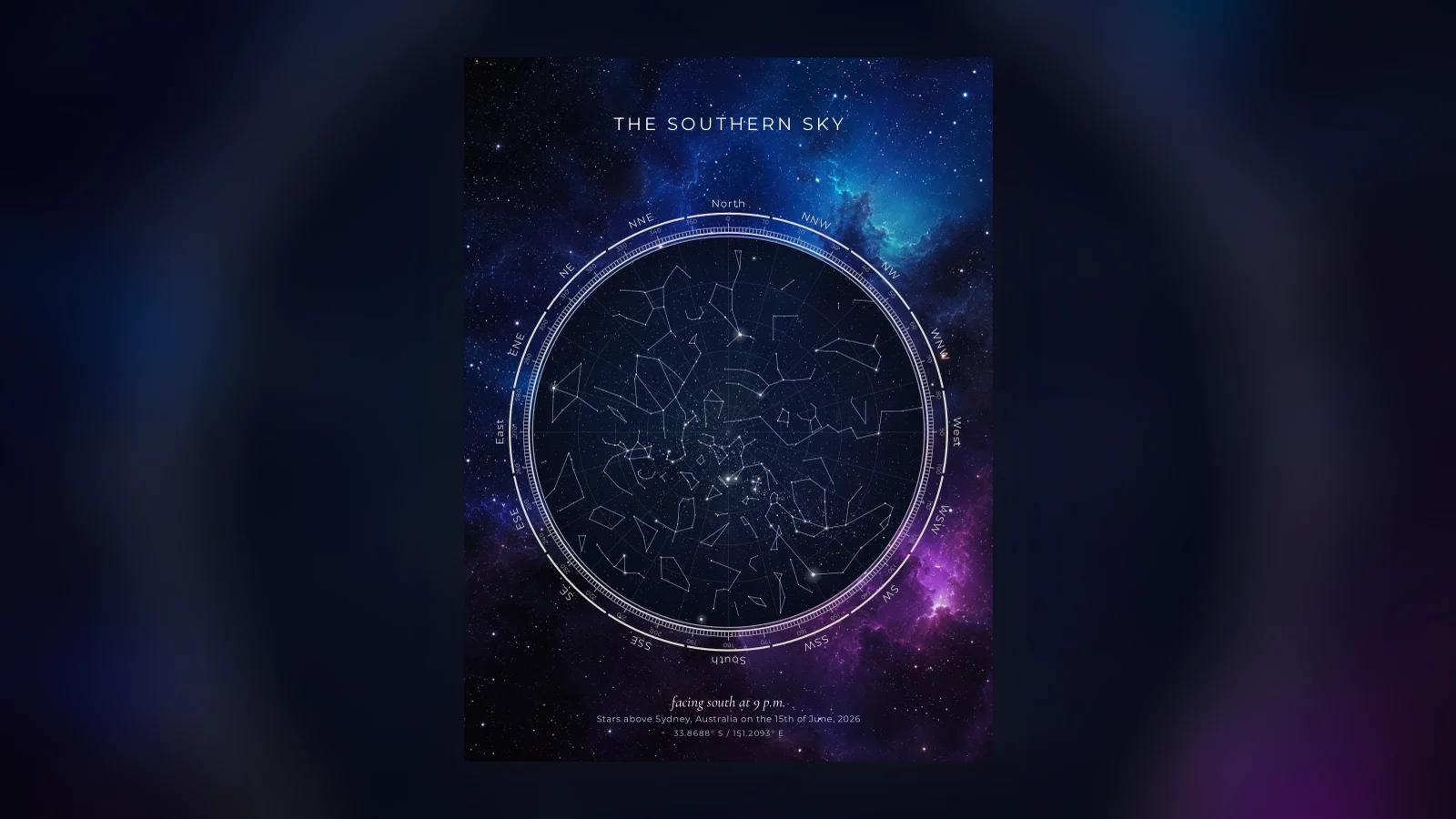
Latitude, not light pollution, is the reason you have never seen certain constellations. It is a geometric fact rather than a matter of luck or timing: from any fixed point on Earth's surface, some parts of the sky are permanently below your horizon, no matter how dark or clear the night. This article covers exactly which ones, and why.
The rule, stated plainly
From any location on Earth, everything within your latitude's angular distance of the celestial pole opposite your hemisphere never rises above your horizon. Standing at 40 degrees north, for instance, anything within 40 degrees of the south celestial pole is permanently invisible to you, regardless of season, time of night, or sky conditions. This is simple geometry: your horizon is tilted relative to the sky's rotation axis by an amount equal to your latitude, and that tilt fixes a permanent blind spot on the opposite side.
The reverse is also true and often overlooked: standing at that same 40 degrees north, everything within 40 degrees of the north celestial pole never sets. It stays above your horizon all night, every night of the year, circling the pole rather than rising and setting like the rest of the sky.
What never sets, and what never rises
From most of the continental United States and Europe, roughly 35 to 55 degrees north, the circumpolar constellations, the ones that never set, include Ursa Major (which contains the Big Dipper), Ursa Minor (containing Polaris, the pole star), Cassiopeia, Cepheus, and Draco. On any clear night, at any time of year, at least part of each of these is above the horizon somewhere in the northern sky, though their exact position rotates through the night as Earth turns.
At the same latitudes, the far-southern constellations, Crux (the Southern Cross), Centaurus, Carina, and their neighbours, never rise at all. They exist purely as a geometric consequence of being too far south of the celestial equator for a northern mid-latitude horizon to ever reach them.

The Southern Cross, specifically
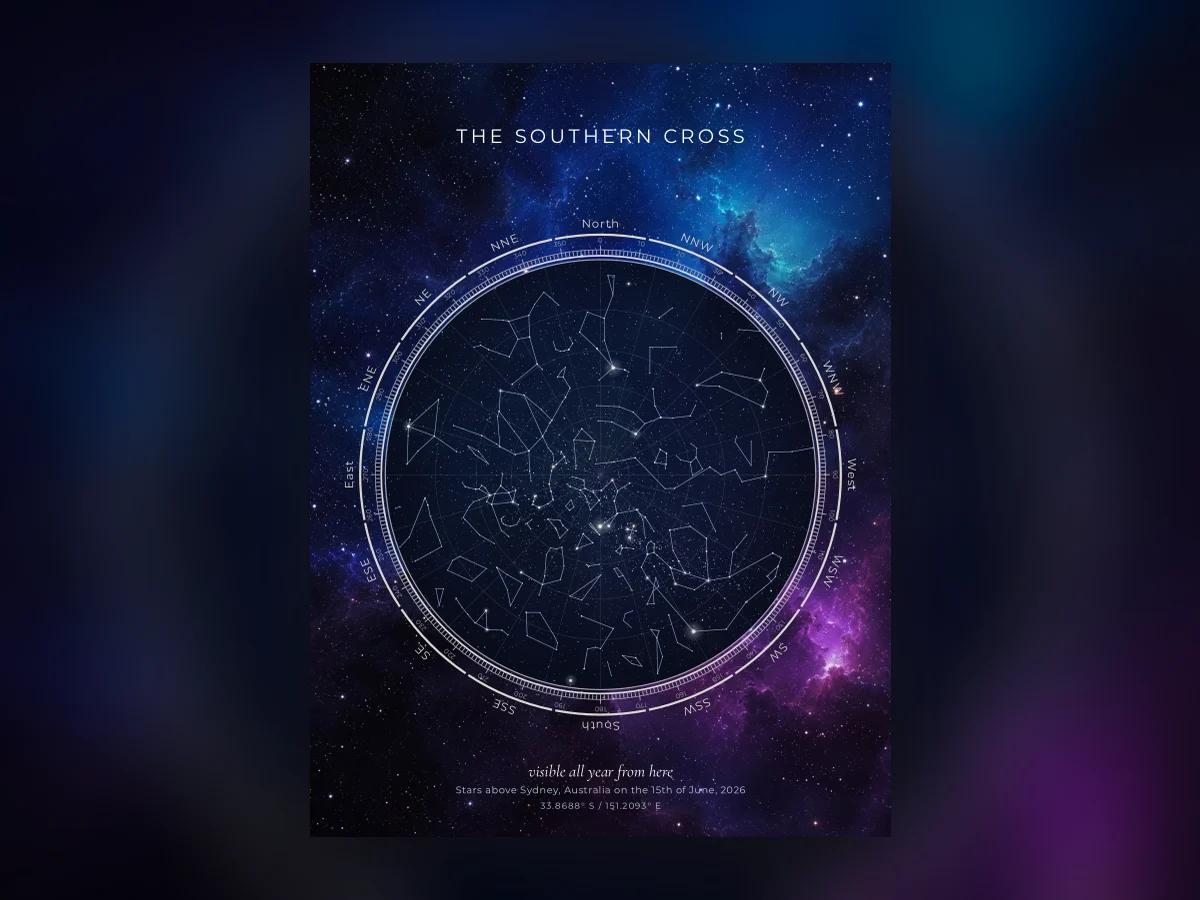
The Southern Cross, formally Crux, sits at a declination that keeps it permanently below the horizon for most of the Northern Hemisphere. The general rule: it becomes visible, at least briefly and low on the horizon, from latitudes below about 25 to 27 degrees north. In practical terms for US travellers, this means the southernmost tip of Florida (around the Florida Keys), the very south of Texas, and Hawaii offer marginal views under ideal conditions and the right season, typically spring evenings in the Northern Hemisphere. Most of the continental United States, sitting above 30 degrees north, cannot see it under any conditions.
For a comfortable, high, easy view of the Southern Cross, you need to travel further: the Caribbean, Mexico south of about latitude 25, or further south still into Central America, South America, Africa, Australia, or the Pacific, where it climbs well clear of the horizon and becomes one of the most recognisable shapes in the sky.
The reverse trip: what a southern traveller misses
The same rule works in both directions. A traveller from Sydney or Cape Town heading north loses the Southern Cross somewhere around the same latitude band and gains, in exchange, the far-northern constellations: Ursa Major and the Big Dipper become visible for the first time once you cross roughly 25 to 30 degrees north, having been permanently below the horizon at home.
This symmetry is one of the more satisfying facts about latitude and the sky: it is not that the Northern Hemisphere has "better" or "worse" stars, only that each hemisphere trades one set of permanently visible constellations for another, with a band around the equator offering a partial view of both.
What season adds on top of latitude
Latitude sets the outer limits of what is geometrically possible. Within those limits, the time of year and the time of night determine what is actually above the horizon at a given moment, since Earth's orbit around the Sun changes which stars sit opposite the Sun, and therefore visible at night, throughout the year. Our companion piece on why the stars look different in summer and winter covers that mechanism in full; this article is specifically about the fixed, latitude-driven limits that apply regardless of season.
Checking your own location
The most reliable way to know exactly what is visible from where you live, on a specific date and at a specific hour, is to run the calculation properly rather than rely on general rules of thumb. Our designer does exactly this: enter your location, date, and time, and it draws the actual visible sky, free in the browser, for any date and place from 1900 to 2100. The accuracy page explains the method behind it, including how latitude and the horizon are handled, and our guide to reading a star map explains what the compass ring and horizon markings actually mean once you have one in front of you.
A few well-known examples of the rule
Sydney, at about 34 degrees south, has the Southern Cross overhead for most of the year and never sees the far-northern circumpolar constellations at all. Singapore, sitting almost exactly on the equator, gets a partial view of both hemispheres' skies over the course of a year, though nothing stays as reliably placed as it does farther from the equator. London, at roughly 51 degrees north, has Ursa Major and Cassiopeia permanently in its sky and the Southern Cross permanently out of reach, no matter the season.
These examples are worth holding onto because they illustrate a point people often miss: two people looking at "the night sky" from different cities are not looking at variations of the same thing, they are looking at genuinely different, only partially overlapping skies, fixed by where each of them happens to stand on the globe.
Latitude and the equinox: a special case
Right around the equator, roughly between 23.5 degrees north and south, both the northern and southern circumpolar constellations become at least partially visible over the course of a year, since the tilt that permanently hides one hemisphere's pole stars is much smaller this close to the equator. Travellers to equatorial regions, parts of Ecuador, Kenya, Indonesia, and similar latitudes, are often surprised to catch a glimpse of constellations from both hemispheres within the same trip, something neither a purely northern nor purely southern location allows.
Why this matters for a personalised map
If you are designing a keepsake for a specific place, a hometown, a wedding venue, a birthplace, the sky drawn for that location will only ever show what was geometrically possible to see from there, at that hour, on that date. A star map from Reykjavik and a star map from Rio de Janeiro on the same calendar date will differ substantially, not because one maker did something differently, but because latitude genuinely changes what is in the sky. That is not a limitation of the method; it is the whole point of computing a sky for one exact place rather than a generic template, the same principle explained in more depth on our accuracy page. If you want to check what is actually visible for your own place and date before designing anything, the designer is free to try, in any of our fourteen designs, and shows the correct sky for wherever you tell it.
A quick reference by latitude band
| Latitude | Southern Cross | Ursa Major / Big Dipper | Notes |
|---|---|---|---|
| 60°N and above | Never | Circumpolar, always up | Far north; short or absent summer darkness |
| 30–50°N (most of US, Europe) | Never | Visible most nights | Standard mid-latitude northern sky |
| 0–25°N | Low on horizon, seasonal | Visible most of the year | Transition zone |
| Equator | Partial view of both | Partial view of both | Widest overall sky access |
| 0–25°S | Visible, moderate height | Low on horizon, seasonal | Transition zone |
| 30–50°S (Australia, southern Africa, South America) | Visible most nights | Never | Standard mid-latitude southern sky |
These bands are approximate and the exact boundary depends on the specific constellation's declination; use the designer for a precise answer at your own coordinates rather than relying on the table alone.
Frequently asked questions
Can you see the Southern Cross from the United States?
Only from the very southernmost parts, and only low on the horizon under ideal conditions. Places below about 25 to 27 degrees north latitude, the southern tip of Florida, southern Texas, and Hawaii, can occasionally glimpse it near the horizon in the right season. Most of the continental US, above roughly 30 degrees north, cannot see it at all.
Why can't I see certain constellations from where I live?
Latitude sets a hard limit on what is geometrically possible to see. From any point on Earth, everything within your latitude's angular distance of the opposite celestial pole never rises above your horizon, regardless of the time of year. This is a fixed geometric fact, not a matter of light pollution or timing.
What constellations can you see from the Northern Hemisphere all year?
The circumpolar constellations near the north celestial pole never set from mid-northern latitudes: Ursa Major, Ursa Minor, Cassiopeia, Cepheus, and Draco are visible on any clear night of the year from most of the US and Europe, though their position in the sky rotates through the night and the seasons.
Does the Southern Cross ever appear in the Northern Hemisphere sky?
It appears very low on the southern horizon for a narrow band of far-southern latitudes in the Northern Hemisphere, but does not rise at all above roughly 30 degrees north. It requires travelling south, to the Caribbean, southern Mexico, or beyond, for a reliable, comfortable view.
How do I find out exactly what I can see from my own location?
Enter your date, time, and location into any accurate sky-charting tool, including our own free designer, which draws the visible sky for any place and date from 1900 to 2100. Latitude determines the fixed limits; date and time determine which of the visible constellations are actually up at that hour.