
 by
by Star Chart, Star Map or Sky Map: What Each One Means
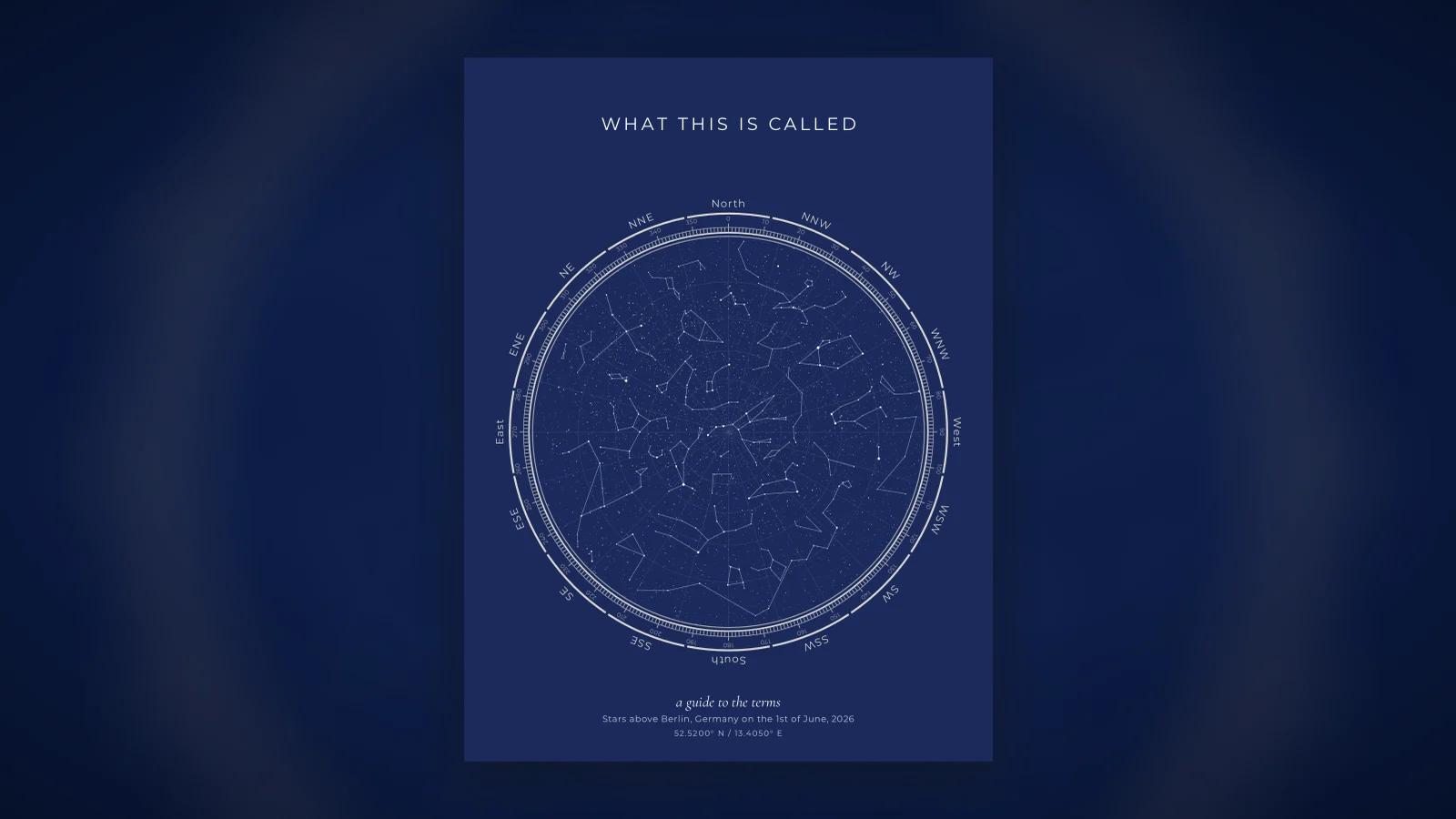
The terms star chart, star map, sky map, celestial map, and planisphere get used almost interchangeably in everyday conversation, and for casual purposes that is fine. But they do carry slightly different technical meanings, and knowing the distinctions helps if you are trying to find, or accurately describe, a specific kind of astronomical drawing.
Why this matters beyond pedantry
Getting the terminology right is not just a vocabulary exercise. If you search for "star chart" expecting a personalised keepsake, you may land on scientific reference tools instead; search for "planisphere" expecting a modern printed gift, and you will find a physical rotating instrument rather than the wall art you had in mind. Understanding the terms helps you search more precisely and helps you describe accurately what you are actually looking for, whether that is a gift for someone else or a tool for your own stargazing.
Star chart
Historically, a star chart leans toward a reference document: a scientific, navigational, or educational plot of star positions, often covering the whole visible sky or even the full celestial sphere regardless of any one observer's location. Ship navigators and astronomers have used star charts for centuries as general-purpose references, not tied to a single night or place. In modern casual use, the term is often used loosely to mean any drawing of stars, including the personalised kind, but its more precise historical sense is the general reference version.
Star map
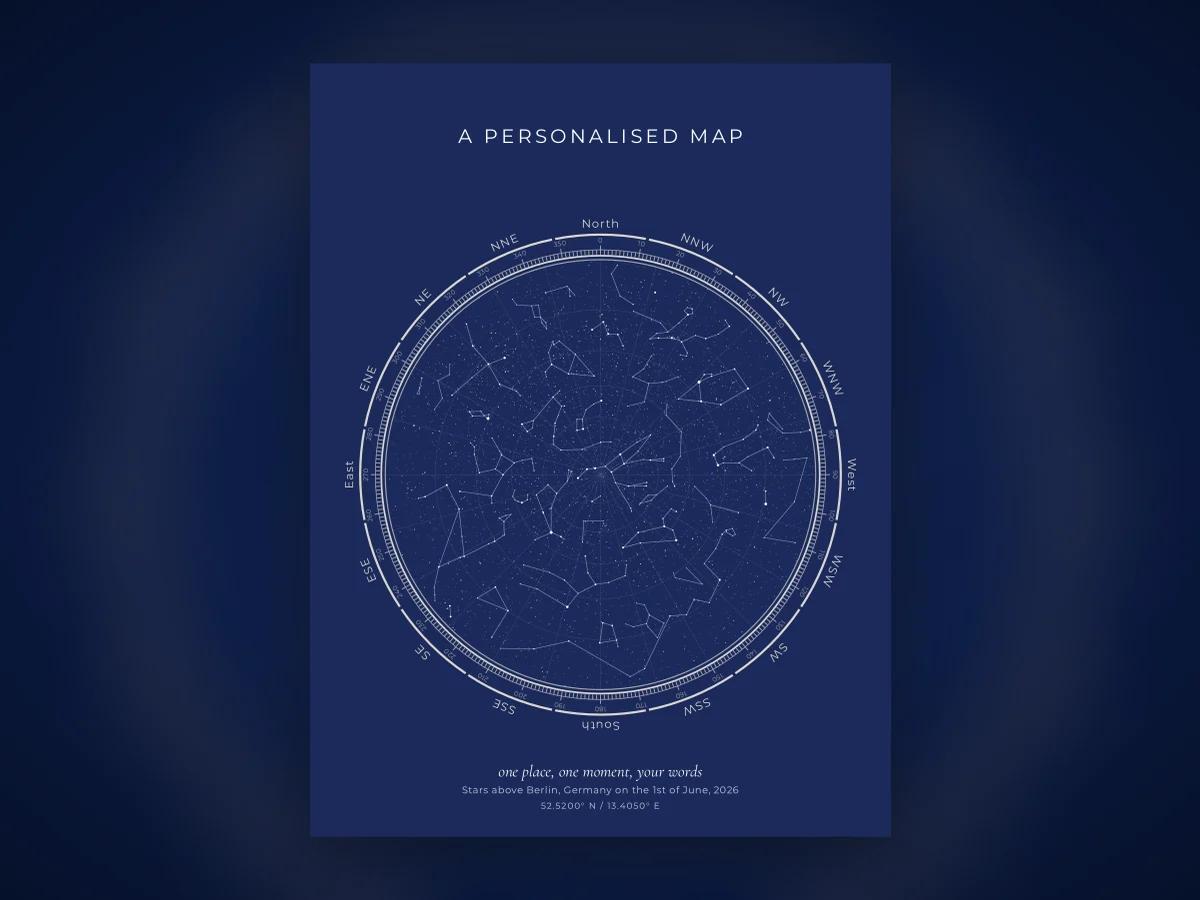
This has become the dominant commercial term for a personalised, single-moment print: the sky as it appeared over one specific place at one specific date and time, typically customised with a title, a date line, and sometimes coordinates. When someone searches for a wedding or birthday gift showing "the sky the night we met," they are almost always looking for what the industry now calls a star map, distinct from the general-reference sense of a star chart. This is also the term we use for our own product.
Sky map
Largely interchangeable with star map in casual use, though sometimes applied more specifically to a chart that includes the visible horizon and compass directions from one location, as opposed to a chart of the entire celestial sphere without reference to any particular observer's viewpoint. In practice, most people use "sky map" and "star map" to mean the same thing.
Planisphere
A genuinely distinct object: a planisphere is a physical, mechanical tool made of two overlapping discs, typically cardboard or plastic. One disc shows the star field for a given latitude; the other has a windowed overlay marked with dates and times. Rotating the discs to align a chosen date with a chosen hour reveals, through the window, which constellations are above the horizon at that moment. Unlike a star map, which fixes one specific night permanently, a planisphere is a reusable, general-purpose instrument for any night of the year, provided you know your approximate latitude. Many amateur astronomers own one specifically for ongoing casual stargazing, distinct from a personalised keepsake of one particular night; the two serve genuinely different purposes and are not really substitutes for each other, despite both plotting stars. Our own guide on how to read a star map covers the compass ring and horizon conventions shared by both formats.
Celestial map
Usually the most formal and comprehensive of these terms, referring to a chart of the entire celestial sphere or a substantial portion of it, often used in academic astronomy, historical cartography, or navigation. A celestial map is less likely to refer to a personalised keepsake and more likely to describe something like an atlas of the whole sky, the kind found in an observatory or a historical collection.
A brief history of the terms
The word "chart" carries a maritime and scientific lineage: navigators have used star charts for centuries to fix a ship's position, and astronomers have used the same term for reference plots of the whole sky going back to the earliest printed atlases. That history is why "star chart" still carries a slightly more technical, reference-document connotation in careful usage, even as casual speech treats it as interchangeable with "star map."
"Map," by contrast, borrows its everyday sense directly from cartography, a drawing of a place, complete with the implication of one specific viewpoint or location, which is precisely why it became the natural term once companies started selling personalised prints of the sky over one specific place. A star chart plots the sky in general; a star map, in this newer commercial sense, plots the sky from somewhere in particular, which is the whole point of a personalised keepsake.
Other terms you may encounter
Constellation map is sometimes used specifically for a chart emphasising the drawn lines and figures over the raw star field, useful when constellation identification is the main point rather than a personalised keepsake.
Night sky print is a more descriptive, less technical phrase that some sellers use interchangeably with star map, largely for search-engine and marketing purposes rather than any meaningful technical distinction.
Astronomical chart leans toward the most formal end of the spectrum, typically implying scientific or educational use rather than a personalised gift.
Star finder usually refers to a simplified tool, sometimes a smaller or app-based version of a planisphere, designed to help a beginner locate a handful of bright stars or constellations rather than provide a comprehensive or personalised record.
Why the terms have blurred together
Commercial gift products have driven most of the blurring. As personalised prints of "the sky on the night you met" became popular gifts, sellers used whichever term ranked well in search or sounded most appealing, star map, star chart, sky map, celestial print, without much regard for the older technical distinctions. The result is that all these terms now largely point to the same product category in everyday searches, even though a strict historical reading would separate them.
Star atlas
A star atlas is a bound collection of multiple charts, typically dividing the whole sky into sections across several pages for greater detail than a single chart could show at once. Historically significant atlases, such as those produced by professional astronomers over the past several centuries, remain reference works rather than gift items, and the term rarely appears in the personalised-gift context at all. If you encounter "star atlas" in a shopping context, it is almost always describing either a genuine reference book or, occasionally, a marketing flourish on what is functionally the same personalised star map product described above.
A side-by-side comparison
| Term | Typical meaning | Fixed to one moment? | Common context |
|---|---|---|---|
| Star chart | General reference plot of star positions | No | Navigation, education, casual use |
| Star map | Personalised print of one place and moment | Yes | Gifts, keepsakes |
| Sky map | Interchangeable with star map, sometimes horizon-specific | Usually | Gifts, apps |
| Planisphere | Physical rotating disc tool | No, reusable | Amateur astronomy |
| Celestial map | Formal chart of the whole sphere | No | Academic, historical |
| Constellation map | Emphasises drawn figures over stars | Sometimes | Educational, decorative |
| Star atlas | Bound collection of multiple charts | No | Reference books |
This table reflects common usage rather than a strict dictionary standard; as noted above, commercial use has blurred several of these terms in everyday conversation, and you will see them used loosely even where the table suggests a clean distinction.
What actually matters, regardless of the name
Whatever term is used, the thing worth checking is the same: does the maker compute real star positions for your specific date, time, and location from an actual catalogue, or is the image a generic decorative pattern with your text overlaid? Our accuracy page explains exactly how we compute ours, using the HYG catalogue and standard astronomical coordinate transforms, valid for any date between 1900 and 2100, regardless of whether you call the result a star map, a sky map, or a star chart.
If you want to see the calculation for yourself, whatever you choose to call it, the designer draws it free in the browser for any place and date in range, in any of fourteen designs. Our piece on famous dates reconstructed as star maps shows the same method applied to well-known historical moments, whatever term you use to describe the result.
Frequently asked questions
What is the difference between a star chart and a star map?
In casual use, almost nothing; both terms describe a drawing that plots star positions. Historically, "star chart" leaned toward a scientific or navigational reference, often covering the whole celestial sphere, while "star map" has become the more common term for a personalised print of the sky over one place at one time, the kind sold as a keepsake.
What is a sky map?
Another largely interchangeable term, sometimes used for a wider view that includes the horizon, compass points, and the visible portion of sky from a specific location, as opposed to a full celestial chart of the entire sphere.
What is a planisphere?
A specific physical tool: two overlapping discs, one showing the stars and one with a windowed overlay showing date and time, that you rotate to reveal which stars are visible at a chosen hour on a chosen night, for a given latitude. It is a general-purpose instrument for any night, not a fixed record of one particular date.
What is a celestial map?
Usually the most formal and comprehensive term, referring to a chart of the entire celestial sphere or a large section of it, often used in an academic, historical, or navigational context rather than for a personalised keepsake of one night.
Which term should I search for a personalised print of a specific night?
"Star map" is now the dominant commercial term for a personalised print of one place and one moment, and is what most makers, including us, use. "Custom star chart" and "night sky print" are common alternative searches that turn up the same category of product.