 by
by Is a Star Map a Good Gift? An Honest Answer

Star maps are one of the more polarising gift categories: some people find them genuinely moving, and others find the whole idea a little precious. Both reactions are reasonable, and the honest answer to whether one is a good gift depends entirely on who you are giving it to.
How it compares to other personalised gifts
Personalised gifts as a category range from the purely decorative, a name printed on a generic template, to the genuinely computed, a result that could not exist without real data specific to you. A star map sits at the computed end of that spectrum when made properly, alongside things like a custom family tree built from real genealogical records or a weather report for a specific historical date. It differs from a personalised mug or a name-printed blanket in one important way: the underlying content is not just customised, it is calculated, which is either a meaningful distinction to your recipient or an irrelevant technicality, depending entirely on who they are.
A short checklist before you buy one, from anyone
Confirm the maker states their star catalogue and magnitude limit rather than just saying "accurate." Confirm they state a supported date range, since claims of accuracy for dates centuries in the past should raise questions. Look at a preview of your own map, with your own date and place, before paying, rather than a generic mockup that may not reflect what you will actually receive. And check the return or refund policy, since a gift that arrives wrong, wrong date, wrong place, a typo in the text, should be fixable or refundable without a fight.
Who a star map suits
It suits someone with a specific date and place that already matters to them: a wedding, a birth, the night they met someone, a proposal. It works best for people who like having something on the wall that means something specific, rather than generic decoration, and who respond to gifts that reference a real, particular moment rather than a category or an occasion in the abstract.
It also suits people who care about accuracy and would rather have something genuinely computed than a decorative pattern with their names on it. If someone has ever asked "but is it actually accurate?" about a similar gift, they are the kind of person a well-made star map will land with.
A test worth applying to any personalised gift
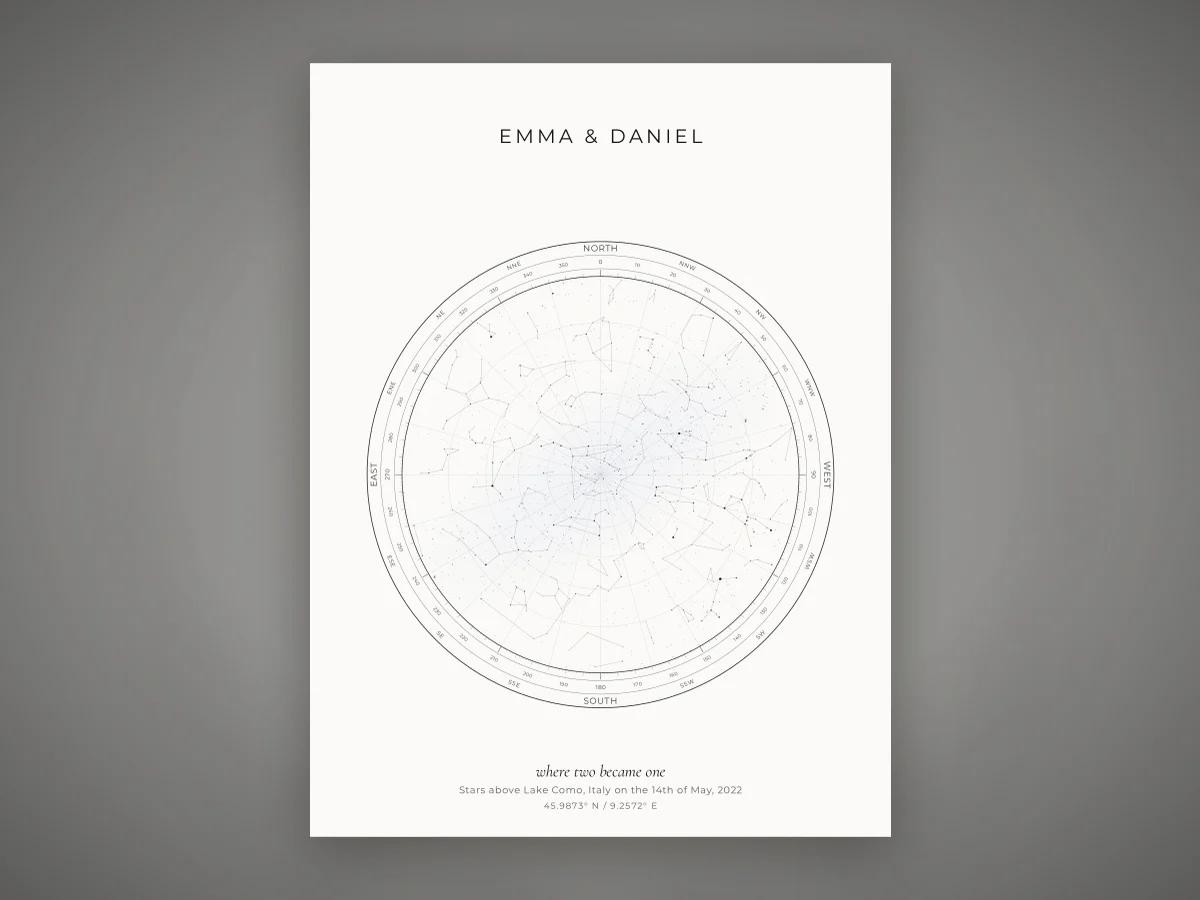
Beyond star maps specifically, one useful test for any personalised gift is to ask whether it would still make sense with a different name and date swapped in. If the answer is yes, an anniversary star map that would look and read identically for any couple regardless of when or where they met, the personalisation is cosmetic. A properly computed star map passes it: swap the date or the place and the whole sky changes, so the personalisation is structural rather than a name printed on a template. A map that looks the same whatever you type in fails it, which is the quickest way to spot a decorative one.
Who it suits, by relationship
| Giving to | Good fit? | What makes it work |
|---|---|---|
| A partner | Usually strong | A night you both remember: the first date, the proposal, the wedding |
| New parents | Strong | The hospital and the hour of birth, with the baby's name |
| Your own parent | Good | Your birth night, from you, on Mother's or Father's Day |
| A couple getting married | Good | The wedding night itself, given before or at the first anniversary |
| A close friend | Depends | Works when there is a shared night worth marking; odd without one |
| A colleague or acquaintance | Weak | Too personal unless you know the date matters to them |
| A grieving family | Handle with care | Can be a comfort; never push it, and let them lead on timing |
The pattern is simple: the closer you are to the person and the more clearly you both know the date, the better it lands.
Who it does not suit
It is a weak gift for someone who consistently prefers experiences to objects, someone with no particular wall space, or someone early in a relationship with no shared date substantial enough to anchor the gift to yet. It is also a poor choice for someone who has been explicit that they want practical, consumable, or experience-based gifts rather than more décor, no matter how personalised the décor is.
And it is a bad gift, full stop, if the date or place is wrong, guessed at, or invented to make the gift possible; the entire value of the format depends on the underlying accuracy, and a fabricated date undermines it completely.
The common objections, answered honestly
"It's just a picture of dots." On a badly made one, yes. On a computed one, the dots are real stars in their real positions for that minute, which is the whole point. Whether that matters is up to the recipient, but it is not decoration.
"The stars don't change, so every map looks the same." They change a great deal. The sky turns about 15 degrees every hour, and shifts again with every mile north or south, so two maps made an hour apart, or a few hundred miles apart, look noticeably different. Our guide on why the stars look different in summer and winter explains why.
"Nobody could ever check it." Anyone can, for free, in about five minutes: enter the same date, time and place into Stellarium and compare. Our article on how accurate star maps are walks through it step by step.
"Isn't this the same as naming a star?" No. Star-naming certificates have no recognition from the body that actually names stars, while a star map simply shows real stars as they were. We compared the two directly in star map vs naming a star.
"A digital file feels cheap as a gift." Only if it is handed over as a link. Printed at a local shop and framed, or given as a framed print, it is a physical object like any other; our guide on gifting a digital file covers how to hand one over properly.
Digital versus framed: which to give
A digital file suits someone who will print it themselves or is happy to keep it on a screen; it is also the only realistic option if you are buying at the last minute, since it arrives within minutes rather than the week or two a framed print needs. A framed print suits someone who wants it ready to hang with no further effort, and generally reads as a more finished gift, at a correspondingly higher price. If you are unsure which the recipient would prefer, the digital file is the lower-risk choice, since it can always be printed and framed later once you know their taste in frames.
What it actually costs
Across reputable makers, digital files typically run $20 to $30, and framed prints range from around $60 for a small size to $150 to $200 or more for a large one, varying by finish and shipping. Our own digital files are $25; framed prints are $69, $109, and $179 across our three sizes, with free shipping to the US and 40+ countries and a 14-day money-back guarantee. Prices well under $10 for a supposedly custom map are worth scrutinising, since they often indicate a generic decorative template rather than a genuinely computed sky for your specific date and place; our comparison of star map companies covers pricing across the category in more detail.
Does the accuracy actually matter to the recipient?
For some recipients, deeply; they will notice or ask, and a fabricated or generic sky will read as hollow once discovered. For others, the accuracy matters less than the sentiment and the visual result, and they would be equally happy with a well-designed but non-computed version. If you know your recipient cares about this kind of detail, verify a maker's method before buying; our own accuracy page states exactly how we compute ours, using the HYG star catalogue, for any date between 1900 and 2100.
How it tends to be received, honestly
The most common positive reaction is genuine surprise at the specificity, particularly when the recipient did not expect the exact place, not just the date, to be part of the calculation. The most common negative reaction, when it happens, comes from a mismatch of gift type rather than execution: a recipient who simply does not connect with wall art or keepsakes will not suddenly connect with this one, however well made.
Star maps also tend to age well as gifts, in the sense that they do not lose relevance the way trend-based or seasonal gifts can; a keepsake of a wedding night means the same thing ten years later as it did on day one, unlike a gadget or a fashionable item that can feel dated within a few years.
What people actually put on them
The wording chosen for a star map often reveals more about whether it will be treasured than the map itself: a specific, understated line, "the night we met," a name and a date, tends to age better than something overwrought. Our separate guide to wording ideas by occasion covers this in detail, and it is worth reading before you buy one for someone, since a poorly worded map undersells even a perfectly accurate sky.
If it isn't right, what to give instead
If you have read this far and suspect a star map is not the right fit, the problem is usually one of three things, and each has a better answer:
- They prefer experiences to objects. Book something specific instead: a class, a trip, a dinner at the place you met. Our anniversary gift ideas list has more than a dozen.
- There is no shared date to anchor it to. Choose something about the person rather than a moment: a book they have mentioned, an upgrade to something they use every day.
- You need it tonight and they would rather have something to hold. Our list of gifts you can give tonight covers options that do not depend on a map at all.
A genuinely honest verdict
If you are choosing this for someone who has a specific date that matters to them and likes having something on the wall, it is a strong gift, better than most alternatives at a similar price point precisely because of how specific it is. If you are choosing it because it seems like a safe, impressive-looking default gift without a real date behind it, or for someone who has told you they do not want more objects, it is the wrong choice regardless of how nicely it is made.
If you think it is right for your situation, the designer is free to try, in any of twelve designs, with the full preview shown before you decide anything, which is the most reliable way to judge whether it actually suits the person you have in mind. Our accuracy page states our own method in full if you want to check it against the checklist above yourself.
Frequently asked questions
Is a star map actually a good gift, or is it a gimmick?
It is a genuine gift for the right person, not a gimmick, provided the maker computes real star positions rather than a decorative pattern. It suits someone with a specific date and place that matters to them and a wall to put something on; it is a poor fit for someone who prefers experiences to objects or has no particular date to anchor it to.
Who is a star map a bad gift for?
Someone who values experiences over objects, someone with no wall space or no interest in displaying keepsakes, a very new relationship without a shared meaningful date yet, and anyone who has been explicit about wanting practical or consumable gifts rather than décor.
How much does a good star map cost?
Digital files typically run around $20 to $30 across reputable makers; framed prints range from roughly $60 for a small size to $150 to $200 for a large one, depending on the maker and finish. Prices at the very low end, under $10, often indicate a decorative template rather than a genuinely computed sky.
Do people actually keep and display star maps, or do they end up in a drawer?
For the right recipient, star maps tend to be kept and displayed for years, since they mark a fixed, specific moment that does not lose relevance the way a trend-based gift can. For a recipient who was never drawn to wall art or keepsakes generally, any print, star map or otherwise, risks the same fate.
What makes one star map better than another?
Genuine accuracy (real star positions from a real catalogue, computed for your exact date, time and place), an honestly stated supported date range, clean and legible design, and print quality that holds up at the size you order. Our own accuracy page sets out our specific method so you can judge it directly.